Polar coordinates offer another way to represent points in a Euclidean plane equipped with an orthonormal coordinate system (see the box in the article " Equations for curves"). It is easy to convert the polar coordinates ( ρ, θ ) of a point M into Cartesian coordinates via the relations x = ρ cos θ and y = ρ sin θ.
The interesting point is that a curve in the plane can then be defined by a polar equation, a relation between ρ and θ. A circle with center O and radius R, or a line through O making an angle α with , has a simple equation (respectively ρ = R or θ = α ). In general, however, lines and circles are represented by more sophisticated equations.
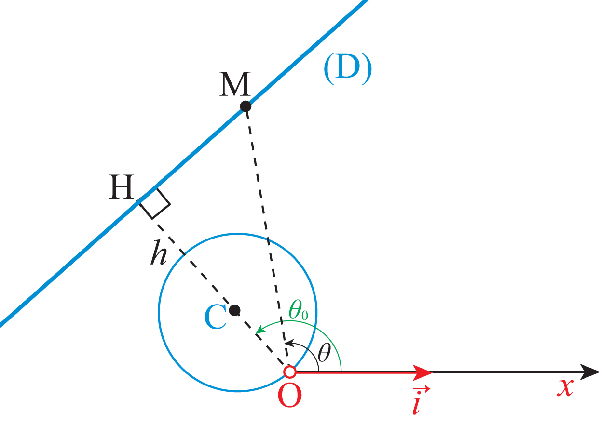
Thus, ρ = h / cos (θ – θ0 ) is the polar equation of the line making an angle θ0 + π/2 with and lying at a distance h from the origin (see figure). We can derive the polar equation of a circle through the origin by noting that inversion* centered at O maps a line not passing through O to a circle through O.
Thus, a circle of radius R passing through O, whose center C lies on line OH, has polar equation ρ = 2R cos (θ – θ0 ).
\ An inversion with center P and power k maps a point M to a point M’ lying on line (PM), such that the product of the directed lengths and is equal to k*.
Circles and rose curves
------------------
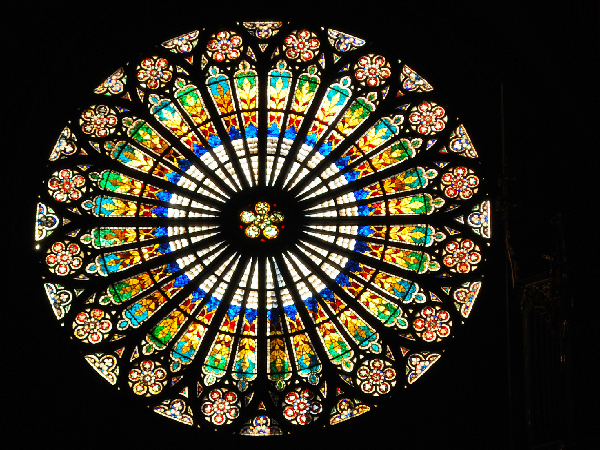
Crowning features of cathedrals and highly decorative elements used in architecture, rose windows originated as curves evoking a rose and its petals, inscribed in a circle and drawn with straightedge and compass. The earliest plans for the great rose window of Strasbourg Cathedral (Bas-Rhin), for example, were produced by Erwin de Steinbach in 1320. A technical feat of Gothic art, it is constructed by dividing a circle into thirty-two "petals", then adding pointed arches and concentric circles based on this division.
There are also more elaborate rose curves, defined by the polar equation ρ = a cos (nθ ), essentially sinusoids in polar coordinates, which were studied by the Italian mathematician Guido Grandi between 1723 and 1728. When n is odd, they have n petals; when n is even, they have 2n petals.
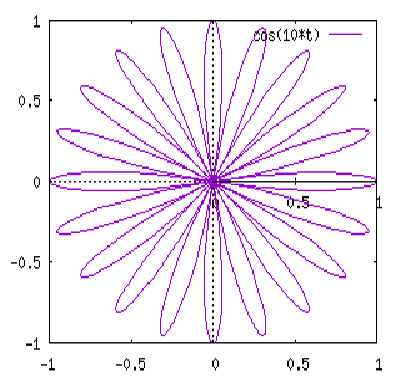
Twenty-petal rose curve with polar equation ρ = cos(10 θ ).
Spirals
------------
Another harmonious curve, the spiral has also been used extensively in architecture, to decorate both column capitals and wrought-iron gates.
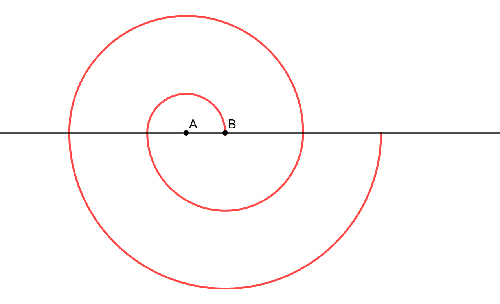
The most common spiral forms found in art are those that can be drawn using only a compass, with several centers and made from tangentially joined circles, and the Archimedean spiral, with polar equation ρ = a θ.
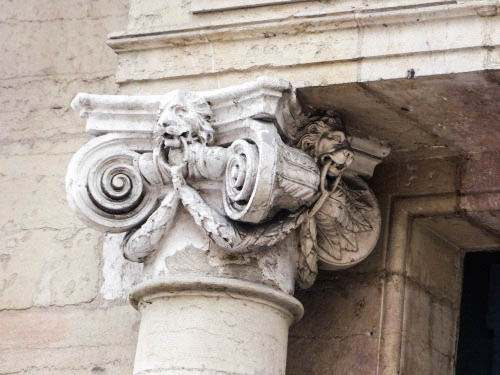
Decorative spirals at the Maison Carrée in Nîmes (Gard).
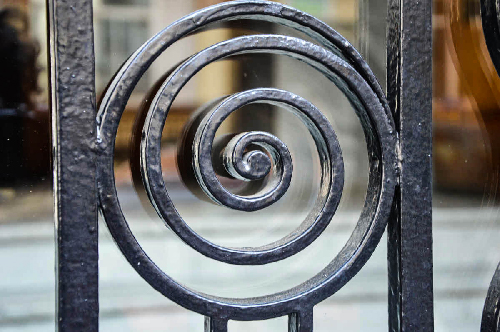
Wrought-iron spiral motif.
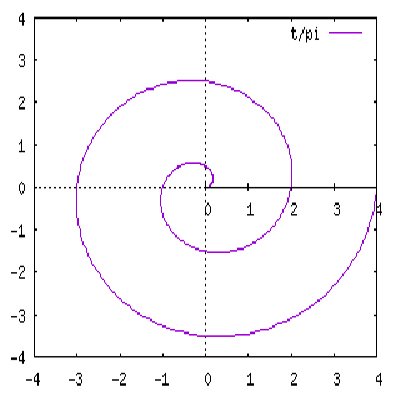
Archimedean spiral with polar equation ρ = θ /π.