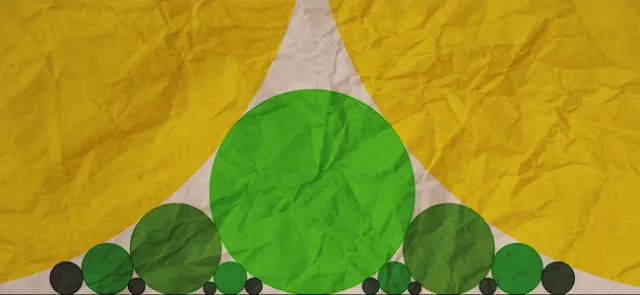
Tangency is a matter of the local linearization of a curve. The circle, which can be regarded as the simplest and most elegant curve, naturally appears in many tangency problems. In the 3rd century BCE, Archimedes, among other things, studied the arbelos (see the article "The Arbelos from Archimedes to Pappus"), and Apollonius of Perga studied problems of contact between circles, lines and points. The Treatise on Contacts of Apollonius survives only through Pappus of Alexandria, one of the chief popularizers of Greek mathematical culture. The partial summaries he made of lost works from antiquity aroused the curiosity of many mathematicians of the 16th and 17th centuries, such as François Viète (1540‒1603) and René Descartes (1596‒1650).
Towards inversion
----------------
At the end of the 15th century, Regiomontanus (1436‒1476) had found an algebraic solution to Apollonius's tenth and last problem, "to find a circle tangent to three given circles."
François Viète then challenged the Belgian physician and mathematician Adrien Romain (1561‒1615) to solve this problem geometrically. Romain quickly provided a solution, but using conics, which could not satisfy a purist: "Eminent Adrien, as long as you touch the circle with hyperbolas, you do not touch it precisely."
François Viète then reconstructs the lost solutions of the Treatise on Contacts in his Apollonius Gallus. Following him, Descartes completes this problem in 1643 with a theorem (see box), which Fermat would later generalize to spheres.