A parabola from three points
-------------------------------------
Start with three points P0, P, and P2. Apply the following two-step algorithm:
Let Q 0 and Q 1 be the midpoints of the two line segments [ P0P1 ] and [ P1P2 ];
Let R be the midpoint of the line segment [ Q 0Q 1 ].
This produces a point R and two triples of points, P0, Q 0, R and R, Q 1, P2, to which the algorithm can then be applied again.
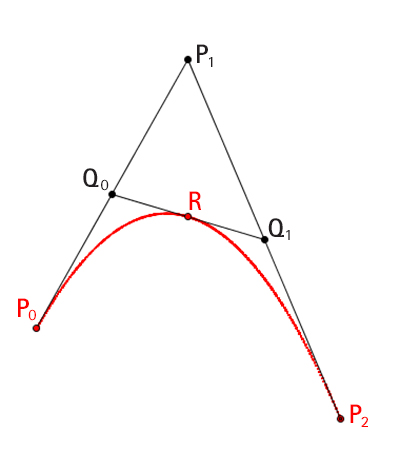
All the points constructed in this way lie on a parabola (which therefore passes through P0, R and P1). The polygon P0P1P2 is called the parabola’s control polygon.
This algorithm, which involves nothing more than drawing line segments and finding their midpoints, is easy to implement (with a ruler and compass, or any dynamic geometry software). It is also well suited to compression processes, since a stopping criterion based on the desired resolution can be added.
-
Increasing the degree
------------------
The algorithm used to generate a parabola (see below) is the de Casteljau algorithm. It can be modified slightly by adding a step, allowing it to be applied to a four-vertex polygon. The resulting curve is a cubic.
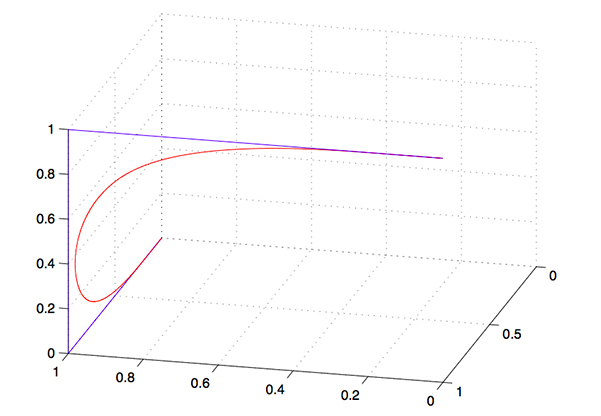
When the polygon’s four vertices are not coplanar, neither is the cubic; the result is a space curve.
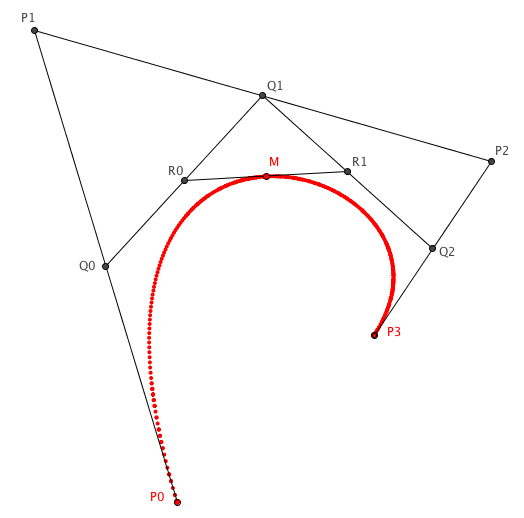
A control polygon with n vertices that has three consecutive non-collinear vertices generates a curve of degree n.
Cutting corners
--------------------
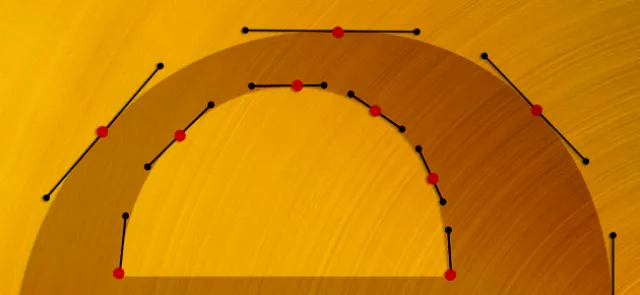
Another curve-generation algorithm, devised by George Chaikin, is based on "cutting corners" of a control polygon (a process known as corner-cutting). At each stage, the resulting polygon is "closer and closer" to the limiting curve. If each side of the control polygon is shortened by one-quarter of its length at both ends and the process is repeated, the limiting curve is a degree-2 spline curve, made up of parabolic arcs joined with C 1 continuity.
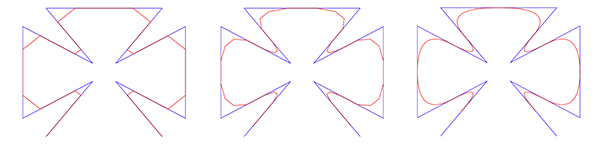
The figures show the curves obtained after one, two
and five iterations of the process.