



Represent curves
Curves have always invaded everyday life. First lines and circles, of course, but also conics, spirals, helices, or others inspired by the line of a building, the layout of a track or the shape of a rope. Yet it is difficult to propose rigorous definitions. We had to wait for the birth of analysis to have a tool to study them. Arising from parametric or implicit equations, expressed in Cartesian coordinates or polar coordinates, they invariably fascinate scientists as well as lovers of beautiful geometry. Welcome to the land of curves!
All articles in this folder
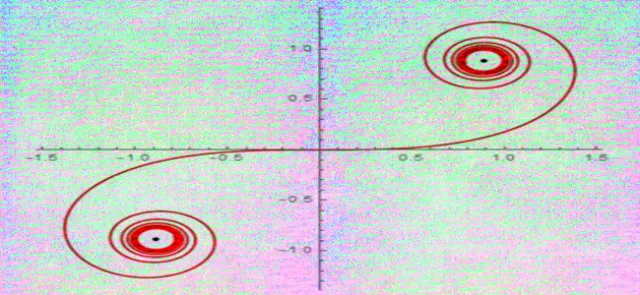
Equations for curves
There are essentially two ways to define a plane curve using equations: with a Cartesian (or implicit) equation, or with parametric equations.

Getting to grips with polar coordinates
Polar coordinates are particularly well suited to plotting and studying circles, rose curves, and other spirals.

Curves that leave the plane
Not all curves in space are confined to a plane. To study these "space curves," several new concepts—curvature and torsion—are introduced using a carefully chosen frame of reference. Get to grips with them and learn how to use them!

An algebraic stroll
Algebraic curves come in every degree and every variety. They can be represented in the real plane, the complex plane or even the projective plane. How can we find our way around? Learn to recognize them and navigate this rich geometric universe!

Elliptic curves
An elliptic curve is an algebraic curve of genus 1, defined by a polynomial equation in Cartesian coordinates with real coefficients.

Generating CAD curves with Bézier | Tangente
Computer-aided design (CAD) emerged with the first computer graphics systems in the field of industrial design. Geometric design algorithms underpin 3D representation.