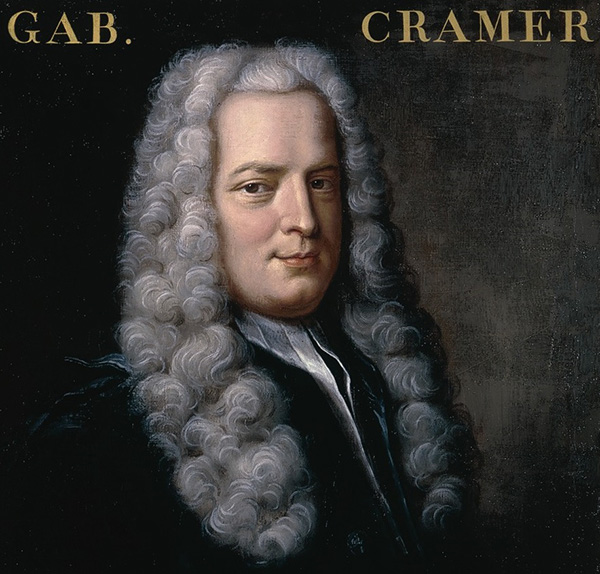
Gabriel Cramer (1704–1752) was born into a family belonging to the intellectual and political elite of the Republic of Geneva, then known as the "Protestant Rome." His father, Jean-Isaac, and his grandfather, also named Gabriel, were physicians and active members of the Republic's Councils. His brother Jean, three years his senior and a professor of law, would serve as first syndic, the Republic's highest office.
After showing considerable academic promise at Calvin's Collège and during two subsequent years of supplementary instruction in belles-lettres (literary studies), he entered the Geneva Academy (the prestigious institution of higher education founded by Calvin in 1559) at barely fifteen to study philosophy and mathematics. In 1722, aged eighteen, he defended theses on sound (Dissertatio physico-mathematica de sono) under the chairmanship of Étienne Jallabert (1658–1724), who had held an honorary chair in mathematics at the Academy before taking up the chair in philosophy in 1713. Gabriel Cramer was by then a promising young man well versed in the ideas of René Descartes (1596–1650) and Isaac Newton (1643–1727).
Early years as a mathematics professor at the Geneva Academy (1724)
Following Étienne Jallabert's death in September 1723, a competitive examination was held to fill the vacant chair in philosophy. Three candidates came forward: Amédée de la Rive (1692–1763), a 31-year-old pastor who was ultimately selected, and two young friends from prominent Genevan families, Gabriel Cramer and Jean-Louis Calandrini (1703–1758), aged nineteen and twenty respectively.