The intellectual journey of Gabrielle Émilie Le Tonnelier de Breteuil (1706-1749) begins with the education her father chose to give her (classical studies, science, literature and philosophy), and with her presence in the literary circle he started at their Parisian townhouse, where she met Fontenelle (1657-1757) and Voltaire (1694-1778), with whom she discussed science. This journey continues with her first "lessons" in Newtonianism, given by Pierre Louis Moreau de Maupertuis (1698-1759) and then by Alexis Clairaut (1713-1765), for as long as she remained in Paris.
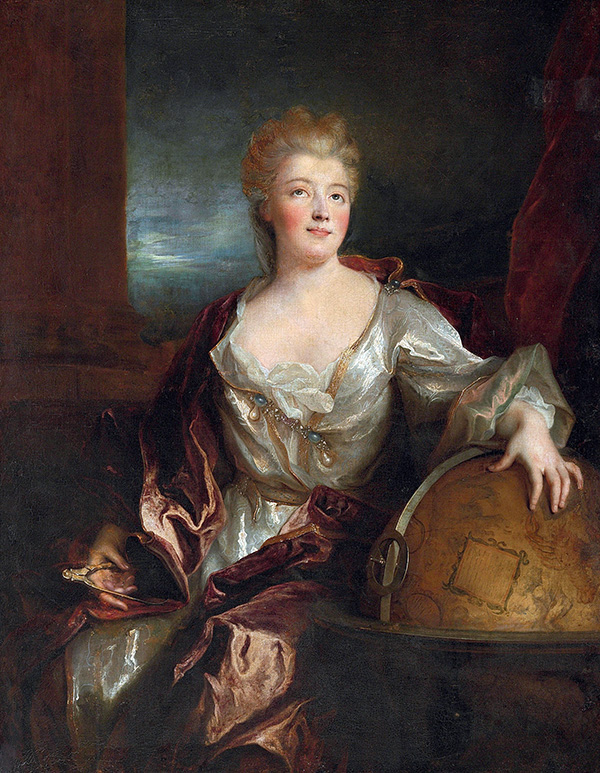
The marquise du Châtelet, painted by Nicolas de Largillière.
A scholar in her own right
Once settled at the Château de Cirey, in Haute-Marne, with Voltaire from 1735 onward, she wrote her first scientific works. Together with the philosopher, she attended experiments on the propagation of fire, which would lead her to write, in secret (see the article), her Dissertation sur la nature et la propagation du feu (Dissertation on the Nature and Propagation of Fire), written in 1738 in response to the competition launched by the Royal Academy of Sciences in 1737. Her paper did not win the prize but would earn great recognition, since it was soon after the first text published by a woman of science in the Mémoires de l’Académie royale des sciences (Memoirs of the Royal Academy of Sciences). It was through her intellectual closeness to Maupertuis, the Bernoullis — renowned Swiss mathematicians — and Leonhard Euler (1707-1783), and through her engagement with the texts of the mathematician and philosopher Christian Wolff (1679-1754) and the Dutch physicist Willem Jacob 's Gravesande (1688-1742), that she wrote and then anonymously published, in 1740, the Institutions de physique (Foundations of Physics). A revised second edition, including part of her correspondence with the then permanent secretary of the Royal Academy of Sciences, Jean-Jacques Dortous de Mairan (1678-1771), appeared in 1742 under her own name. Accusations of plagiarism, made by the German mathematician Samuel Kœnig (1712-1757), quickly led her to make herself known as the author of this text. Addressed to her son, this text at first glance appears to be a physics textbook meant to present the metaphysical foundations of modern physics. But in this work, Émilie du Châtelet proposes, on the one hand, a subversion of the gender stereotype: in the foreword, reversing the device of Francesco Algarotti's successful text, Le newtonianisme pour les dames (Newtonianism for Ladies) (see the article), she is the learned woman who teaches a young man what he must know about physics (see box). On the other hand, instead of a mere exposition of Leibniz's (1646-1716) metaphysical principles and Newton's (1642-1727) physics — which would amount to a lack of philosophical originality — this text proposes an original philosophy of science.