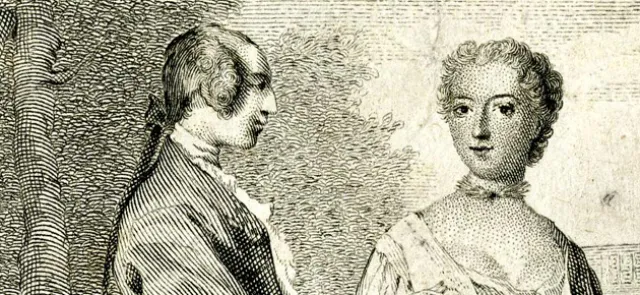
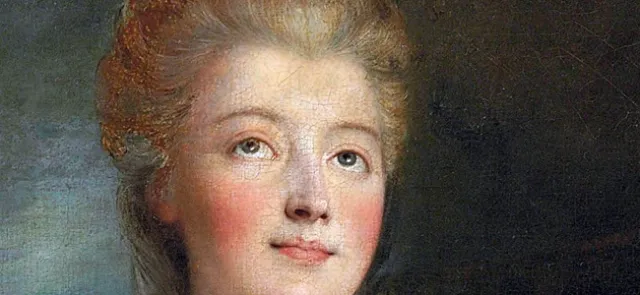
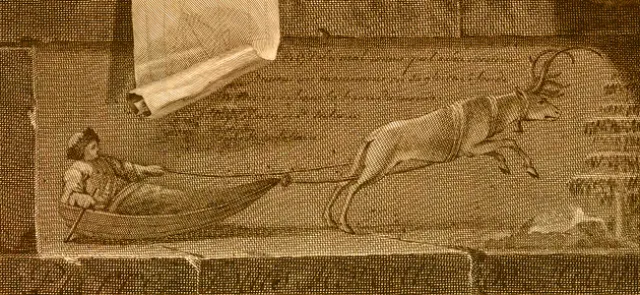
It was thanks to her father that Émilie du Châtelet received an education comparable to that of her brothers, given by private tutors, through which she developed an early curiosity for the sciences and a command of languages. A few years after her marriage, she met and began a relationship with Voltaire (1694-1778), whose literary work should not overshadow his interest in the new sciences, and in particular in the discoveries of the famous English scholar, whose method he hoped to spread by publishing in 1738 the Éléments de la philosophie de Newton. In the meantime, Émilie du Châtelet had become skilled in Leibnizian infinitesimal calculus, notably with the academicians Pierre-Louis Moreau de Maupertuis (1698-1759) and Alexis-Claude Clairaut (1713-1765), which reinforced the admiration that Voltaire, whose own mathematical abilities were relatively limited, had for her.
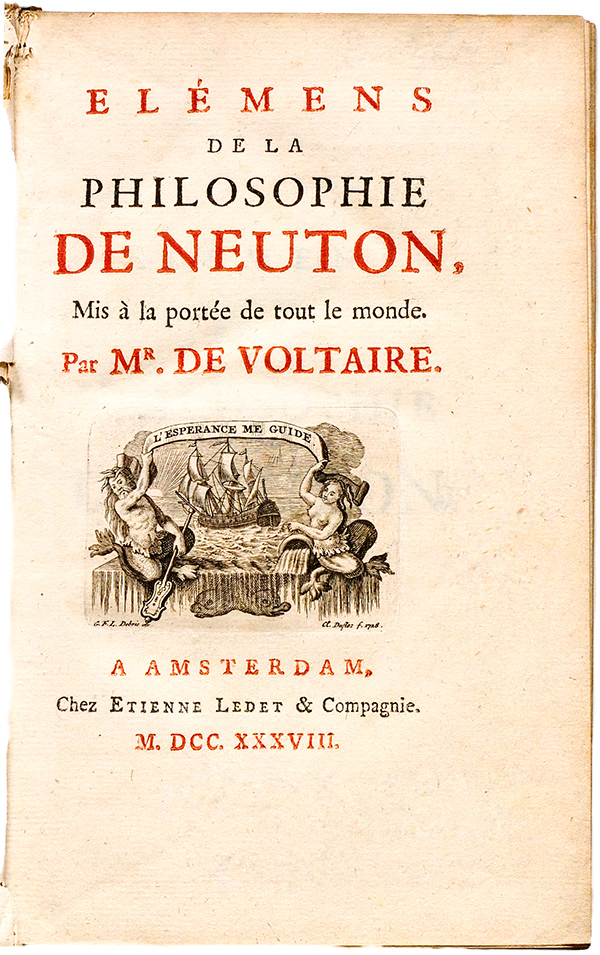
Cover of the popularization book on Newtonianism signed by Voltaire,
but to which Émilie du Châtelet contributed.
The origins of the translation project