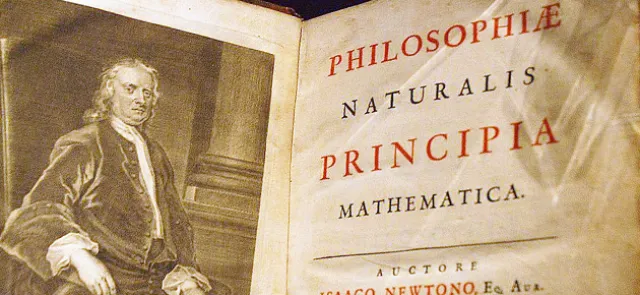
The prerevolutionary 18th century, whose emblematic figures included Voltaire and Rousseau, was marked by a great thirst for new ideas and knowledge. Through his various studies, particularly of the three-body problem, Alexis Clairaut did more than anyone to advance the central scientific debate of the Enlightenment—a debate that may seem unremarkable today, but was extraordinarily difficult and delicate: the validity of the law of universal gravitation proposed a few years earlier by Isaac Newton (1643–1727).
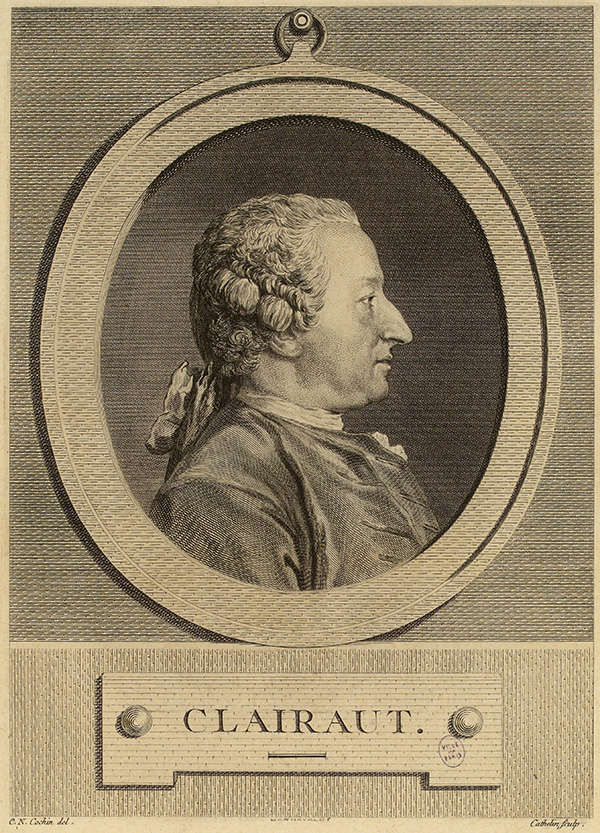
Alexis Clairaut (1713–1765).
Clairaut was also remarkable for having begun his career at a very young age, having "absorbed geometry with his mother's milk," as one of his biographers, Abbé Charles Bossut (1730–1814), put it. The son of a mathematics teacher, he presented his first paper to the Académie des sciences at the age of twelve years and eleven months, before becoming a member at eighteen! His candidacy was bolstered by the publication of his first book, Recherches sur les courbes à double courbure (Paris, 1731), a substantial treatise on so-called skew curves, which cannot be drawn in a plane.