At the beginning of the preface to his Élémens d’algèbre, Clairaut explains: "I have endeavoured to present the rules of algebra in an order that their inventors might have followed. No truth is presented in the form of a theorem; all appear to be discovered through tackling problems prompted by necessity or curiosity."
And this is precisely what he does, opening the first part with a range of problems that can all be solved using the same universal technique: take the desired quantity as the unknown, then solve the resulting equation. Each problem thus provides an opportunity to explore a technique of algebraic manipulation.
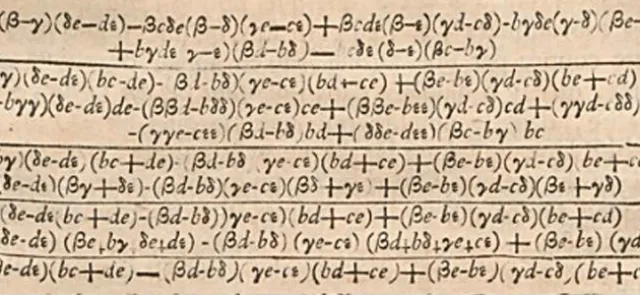
With great pedagogical skill, Clairaut then introduces algebra's second distinctive feature: the ability to address a problem in full generality by replacing numerical data with letters, which are manipulated according to the same rules discovered earlier. Every pedagogical choice—and there are many—is explained beforehand in the preface.
The book has five parts. After covering general principles through solving linear equations, the second part turns to solving quadratic equations. On the technical side, this provides an introduction to algebraic manipulations involving radicals. A third part surveys equations of arbitrary degree. Here the aim is not to present a method of solution, but to establish general facts about the properties of solutions that can be deduced from the form of an equation. Clairaut then tackles certain special equations of arbitrary degree before concluding, in the fifth part, with the general problem of solving cubic and quartic equations.