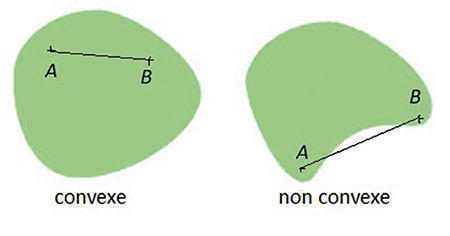
A subset D of the plane is convex if, whenever any two points A and B in D are chosen, the entire line segment joining them also lies in D. The points on the segment are precisely the convex combinations of its two endpoints. By associativity of convex combinations, this property is equivalent to saying that every convex combination of finitely many points of D belongs to D.
One of the problems that arises in applications of convexity is determining the convex hull of a region: it is defined as the smallest convex set containing that region. It is therefore also the intersection of all the convex sets containing it.
The Carathéodory–Steinitz theorem
------------------------------------
Although the convex hull of a region often looks obvious in a diagram, it can sometimes be difficult to determine. After all, how can we find every convex set containing it? This is what makes the following result so useful: every point in the convex hull of a subset D of the plane can be written as a convex combination of at most three points of D. For bounded D, this theorem dates from 1907 and is due to the Greek mathematician Constantin Carathéodory (1873–1950). It was generalized in 1914 by the German mathematician Ernst Steinitz (1871–1928) to all subsets D, bounded or otherwise.
Furthermore, further refinements, proved in 1929 by the Danish mathematician of German origin Moritz Werner Fenchel (1905–1988) and then in 1934 by the Dutch mathematician Lucas Nicolaas Hendrik Bunt (1905–1984), show that if D has at most two connected components ("pieces"), then every point in the convex hull of D can be written as a convex combination of two points of D: there is no need for any more!
All these results generalize to spaces of dimension n (with n + 1 points in general, and n points if the region D has at most n connected components).