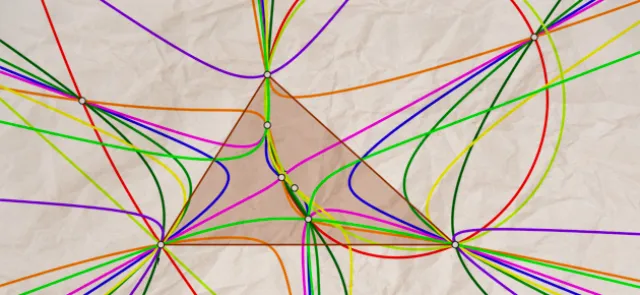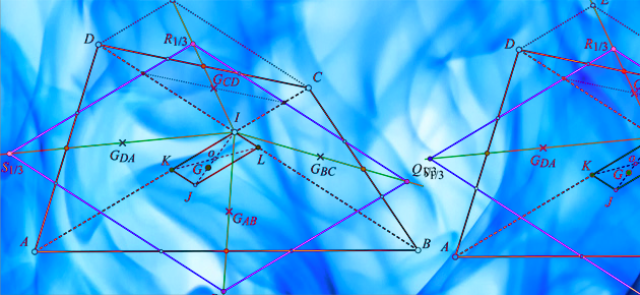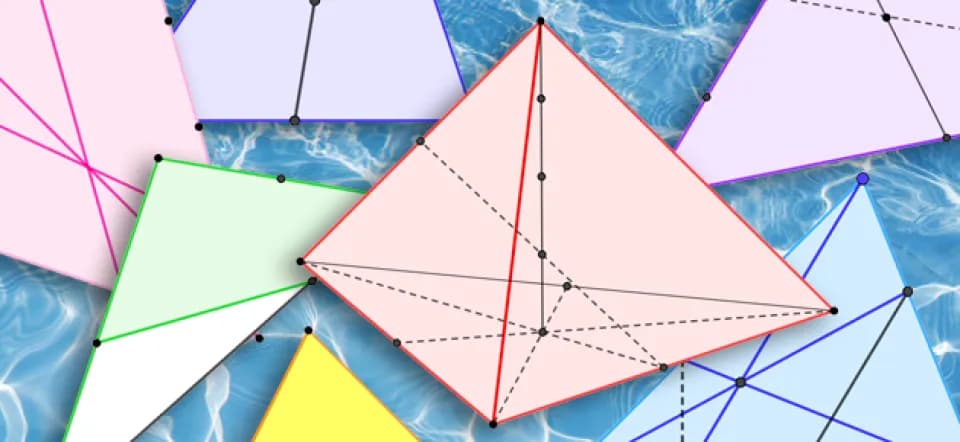
Above all, it is the remarkable property known as associativity of barycenters that makes this concept a tool of choice for proving that points are collinear and lines concurrent. Here we shall consider the barycenter of a system of n weighted points {A1(a1), A2(a2)… A*n(an*)}. This property has a simple form: the barycenter of a system of weighted points is unchanged if one or more of its points are replaced by their own barycenter, assigned the sum—which must be nonzero—of the corresponding masses. Associating points in this way, or conversely splitting them apart, will not only reveal elementary properties of certain configurations, but also provide quick, elegant, calculation-free proofs that a number of points are collinear or that several lines meet at a single point.
The basics of barycenters
--------------------------
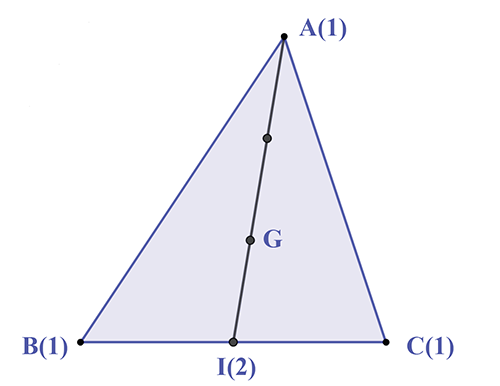
Though barycenters have all but vanished from today's school curricula, they allow us to locate points relative to one another and prove useful even in geometrically simple settings. For example, while it is generally known that the three medians of a triangle meet at its "center of gravity," one may not know its exact location. By turning the question around and considering the barycenter of the three vertices A, B and C, each assigned mass 1, we can both locate it precisely and show that it is indeed the intersection of the medians. By grouping the points B(1) and C(1) using associativity, whose barycenter is the midpoint I of the line segment [BC], and assigning I mass 2, we see that G, the barycenter of the system {A(1), B(1), C(1)}, is also the barycenter of another system: {I(2), A(1)}.