In the 17th century, following "his" invention of analytic geometry (see the article "An elusive geometric concept", § Towards the modern era), René Descartes knew how to determine the tangents to a given geometric curve. Using a notion of "infinitely small numbers", his contemporary and correspondent Pierre de Fermat (c. 1601–1665) did so for a host of curves, both geometric and mechanical. Consider the folium of Descartes, the curve with equation x3 + y3 – 3xy = 0. In Descartes's terminology, this is an example of a geometric curve: it does not arise from a mechanical construction. In modern terminology, it is a cubic—that is, an algebraic curve of degree 3. Although Descartes considered the calculation of its tangents difficult, Fermat carried it out elegantly.
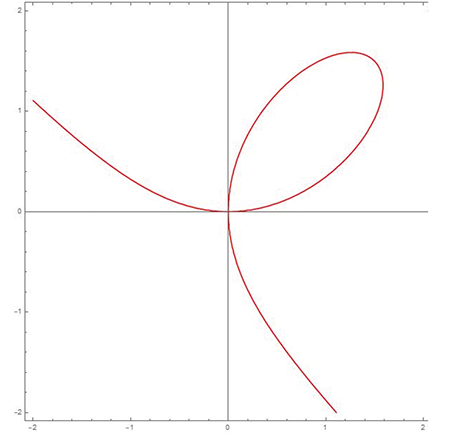
The folium of Descartes.
This marked the dawn of calculus, which Isaac Newton (1642–1727) and Gottfried Wilhelm Leibniz (1646–1716) would go on to develop. Pierre-Simon Laplace (1749–1827) would later declare in his Programme: "One of the most fruitful connections ever made in science is the application of algebra to the theory of curves. The investigation of their properties led to calculus, whose discovery transformed mathematics."
Analysis and the classical era
------------------------------