A prolific author
----------------------------
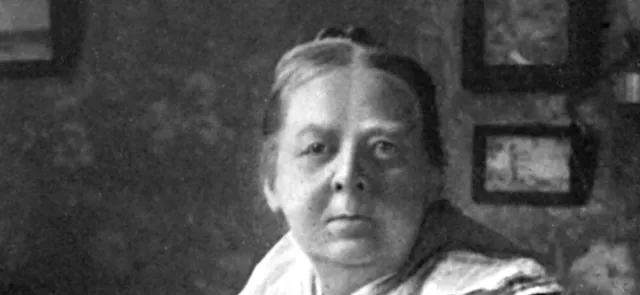
Mary Everest (1832–1916) met George Boole in 1850. He had become something of a mathematics tutor to her, as she had not been allowed to study the subject because universities were closed to women. They married in 1855. When George died in 1864, she was left to support their five daughters and had to take on various odd jobs. She went on to teach mathematics, including at Queen’s College, which had been founded primarily to train future "nurses".
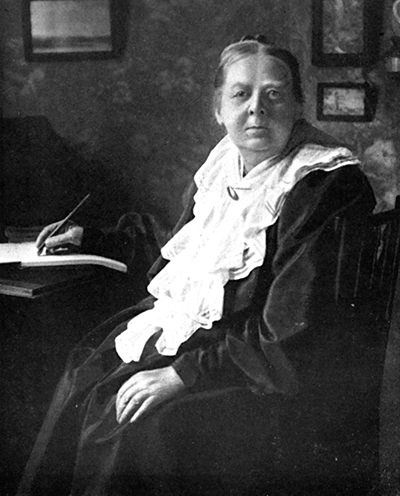
Mary loved teaching and devised highly innovative methods—probably too innovative for her time. From 1889 onward, she wrote numerous books on mathematics education, also weaving in religion, philosophy and a touch of esotericism, which did not make for easy reading. Their titles are highly evocative: Logic Taught by Love in 1889, The Cultivation of the Mathematical Inspiration in 1902, Lectures on the Logic of Arithmetic in 1903, The Preparation of the Child for Science in 1904, Philosophy and Fun of Algebra in 1909, and Some Master Keys of the Science of Notation in 1911. The full list is very long indeed!
While her husband was writing his major work, The Laws of Thought, the couple discussed at length ways of thinking about mathematics. George Boole was himself passionate about mathematics education and drew on his own experience as a self-taught mathematician. Mary devoted her life to popularizing her husband’s ideas, and her teaching methods were one means of doing so.
Differential calculus through sewing
-------------------------------------
Mary Everest Boole’s ideas about education involved play from an early age and hands-on work with objects (spheres, cubes, cones, small sticks…). Her great invention was curve stitching, or "sewing cards," also known as "thread boards," which could be used from kindergarten all the way through university. This makes it possible to ask questions about curves, imagine new ones, work with numbers and operations, think about two, three and even four dimensions, and above all gradually arrive at the concepts of differential calculus, equations of curves and more.
Mary pointed out that drawing straight lines with thread and a needle was much easier than using a ruler, adding mischievously that boys and girls alike learned mathematics by sewing! Her ideas have been taken up in modern calculus textbooks. They are also widely used in art.
The curves of string art
---------------------------
Born from Mary Everest Boole’s imagination in the 19th century, artistic creations made from nails and taut strings became popular under the name string art.
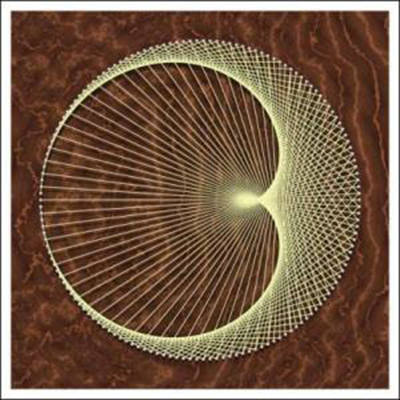
A cardioid in string art.
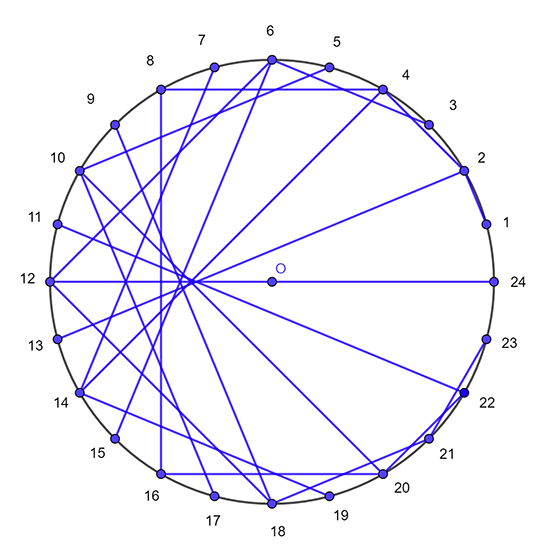
These constructions can produce attractive curves that are tangent to every line in a given family—that is, envelopes of a family of lines. A simple example is the envelope of the chords of a circle. Suppose, for instance, that 24 numbered nails have been placed around a circle of radius 1, 15° apart, and that strings are stretched from nail 1 to nail 2, from nail 2 to nail 4, from nail 3 to nail 6, and so on. A heart-shaped curve then appears, tangent to every chord. The chords constructed this way are lines passing through the points A(cos t, sin t) and B (cos 2t, sin 2t), and the resulting curve is the envelope of this family of lines. Its parametric equations are
this is a cardioid with a cusp at (−1/3, 0).