The French curve
-----------
How could anyone forget its graceful shapes? Some call it a pistolet, others a perroquet, while English speakers call it a French curve. With no mechanical parts, this small drawing tool is operated by hand and helps draughtspeople and dressmakers alike draw elegant curves.
Made of metal, plastic or wood, like the three-piece set designed by the German geometer Ludwig Ernst Hans Burmester (1840–1927) shown here, the upper piece is used to draw parabolas, the middle one ellipses, and the lower one hyperbolas. Segments of these curves, in various sizes, are joined together as harmoniously as possible while remaining continuously differentiable.
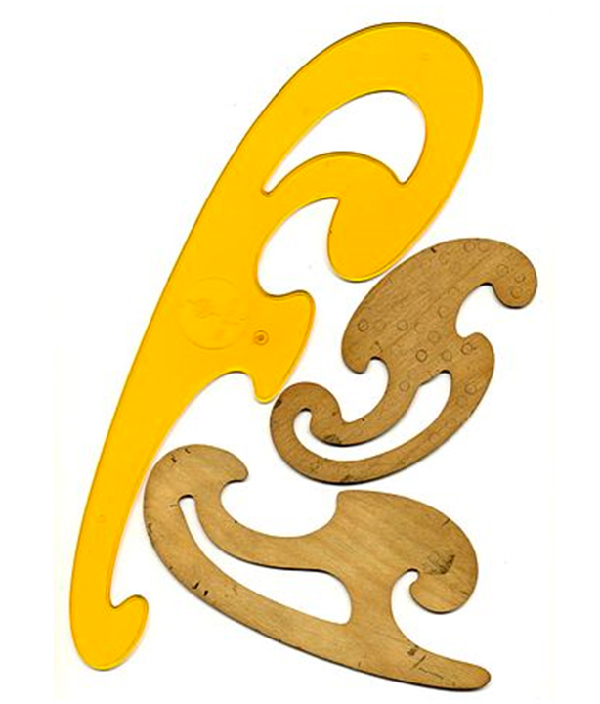
Set of French curves.
The harmonograph
---------------
A relatively elaborate drawing mechanism is the harmonograph, "a cross between a writing desk and a grandfather clock", as Alex Bellos so aptly puts it in his book *Alex et la Magie des nombres* (Robert Laffont, 2015).
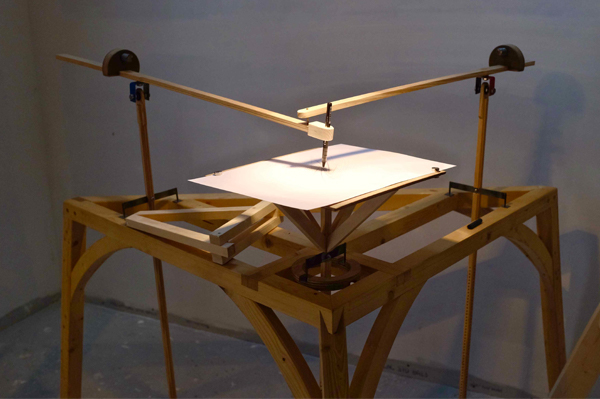
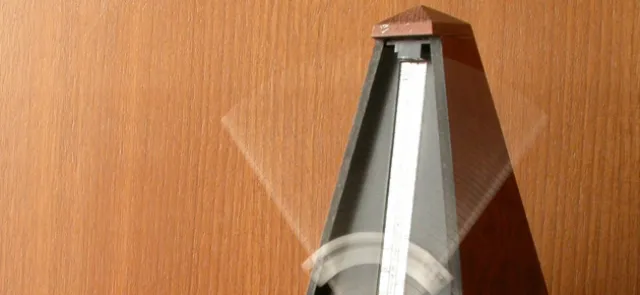
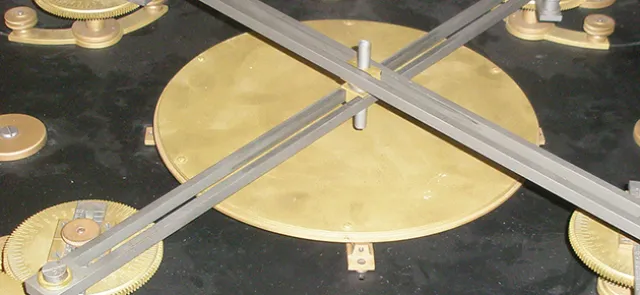
Using the oscillations of two pendulums and a system of rods connected to a pencil, this mechanical device draws curves on a sheet of paper by combining the pendulums' motions. One moves the pencil back and forth along an axis D1; the other moves the paper back and forth along an axis D2 perpendicular to D1. As a function of time t, each motion is described by x(t) = A sin(t f + p) e −*dt, where f is the frequency, p the phase angle, and d* a damping factor. The first such device, devised by Bailie Hugh Blackburn (1823–1909), appeared in a popular science book in 1879. It has since become widespread, particularly as a children's toy, and has spawned numerous variants. Depending on the frequency and synchronization of the pendulums, it can draw ellipses, spirals or, more spectacularly, Lissajous curves.
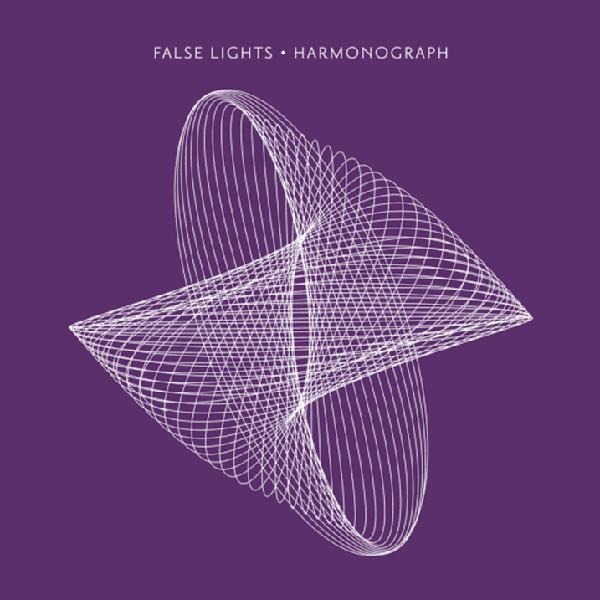
The album Harmonograph by the British band False Lights (Wreckord Label, 2018).
The spirograph
This drawing instrument is nothing more than a toy for producing attractive curves. Its name is now a registered trademark (Hasbro, 1998), but the German painter and mathematician Albrecht Dürer (1471–1528) had already described these curves in 1525.
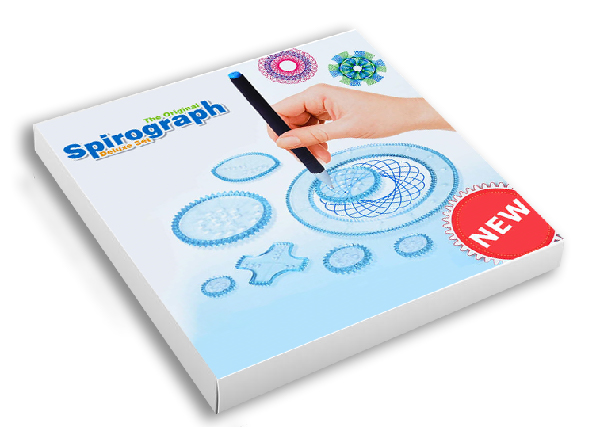
The device consists of toothed wheels with holes into which a pencil can be inserted; these wheels roll inside rings that are also toothed. The user sets the system in motion by turning the wheel with the pencil, producing intricate shapes known as hypotrochoids. These are the curves traced by a point P fixed to a circle (C), centered at O, that rolls without slipping inside a fixed circle (C 0 ). Let R be the radius of (C 0 ), r that of (C) (with r < R), and d the distance OP. Such curves have the complex parametric equation with 0 ≤ t ≤ 2π.
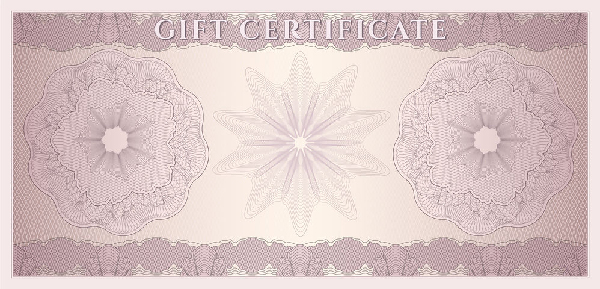
The first Spirograph was developed by the British architect Peter Hubert Desvignes (1804–1883). The resulting figures make clear why it was originally intended for drawing the fairly fine and subtle "guilloche" patterns used to protect official documents (certificates, banknotes…) against counterfeiting.