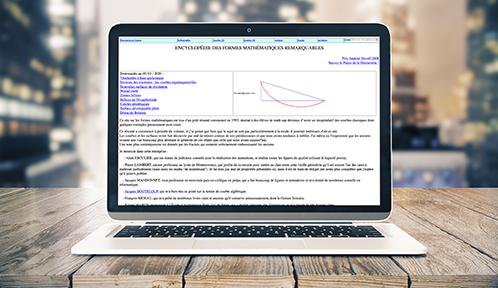
The vast Mathcurve.com website
--------------------------------
Subtitled "The encyclopedia of remarkable mathematical forms," **www.mathcurve.com* catalogs hundreds of them: plane curves, referred to here as 2D curves (about 550 sections); space curves, or 3D curves* (about 150 entries); surfaces (about 300 cataloged); fractals (about 90 items); and polyhedra (more than 250). It is undoubtedly THE French-language reference on the subject—and perhaps even the leading reference worldwide, since almost every page on the site has been translated into English by the young mathematician David Michel.
Founded in 1993 by Robert Ferréol, a teacher in France's post-secondary preparatory classes, to satisfy his students' curiosity, the site is constantly updated. It has grown over the years to a scale that its creator probably never imagined at the outset… His work was recognized in 2008 with the Anatole-Decerf Prize, awarded by the Société mathématique de France for work in teaching or popularizing mathematics education (see the "Plane curves" feature, Tangente 125, 2008). The modest sum received on that occasion helped fund the translation of the site into English.
For each curve or surface, the corresponding section presents its various equations, graphical representation, historical origins and mathematical properties. Graphical animations illustrate some of its geometric, dynamical, or kinematic properties.
Alongside classical curves such as conics, cissoids and spirals, the site also features some surprising examples, including the trisecting limaçon, the hypotrochoid and the devil's curve. Browsing the site is like wandering through the countryside and coming across a wealth of wildflowers, each more beautiful and astonishing than the last.
The first French-language book devoted to curves
---------------------------------------------------
The three works by French mathematician Henri Brocard provide no proofs, but offer an impressive list of non-trivial properties for each curve or family of curves. Unfortunately, the published work is incomplete: its alphabetical arrangement jumps, for example, from "abaque" to "glissette." It does, however, include every curve whose traditional French name begins with "courbe." There are occasional surprises: Lissajous curves must be sought under "F," not "C," because the author calls them "figures de Lissajous"!
Pierre-René-Jean-Baptiste-Henri Brocard (1845–1922) had previously published a less detailed but more comprehensive manuscript, Notes de bibliographie des courbes géométriques (Bibliographical Notes on Geometric Curves; Bar-le-Duc, 1897), followed by Partie complémentaire (Supplement; Bar-le-Duc, 1899). His name lives on in the Brocard points and the Brocard circle associated with a triangle.
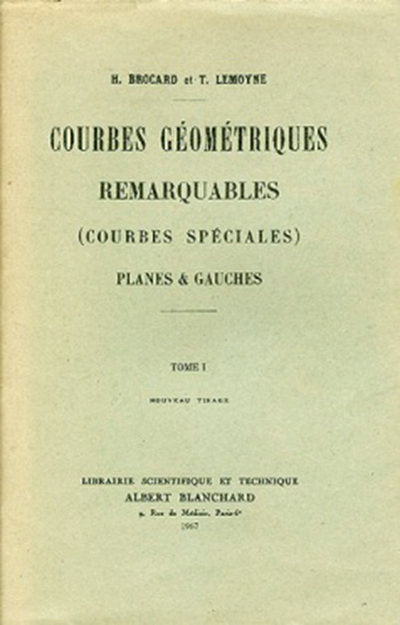
Courbes géométriques remarquables (courbes spéciales) planes et gauches. (Remarkable Plane and Space Curves.) Henri Brocard and Timoléon Lemoyne, Vuibert, 1919; reissued in three volumes by Albert Blanchard in 1967.
Three comprehensive volumes
---------------------------
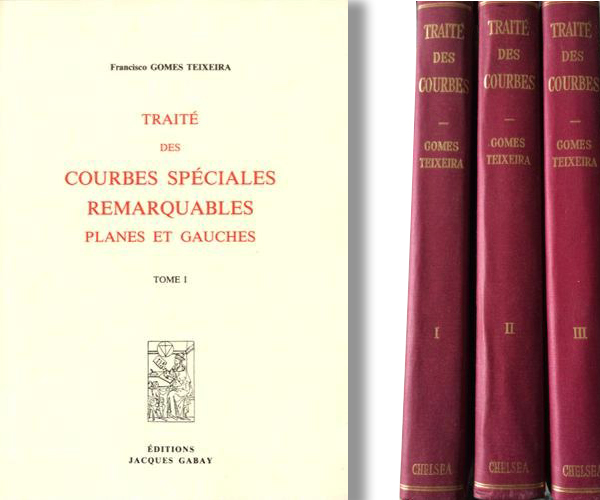
These three comprehensive works on curves contain proofs—sometimes involving extensive computation—of every property listed. Although Francisco Gomes Teixeira (1851–1933) was Portuguese, his work was originally written in Spanish, something that occasionally shows in the French translation. Teixeira's aim was to bring Portuguese mathematics into the international scientific community. To that end, he founded Portugal's first mathematics journal in 1897 (see our "Iberian mathematics" feature, Tangente 144, 2012); French was its principal language.
*Traité des courbes spéciales remarquables planes et gauches.* (Treatise on Remarkable Special Plane and Space Curves.) Francisco Gomes Teixeira, three volumes, 1909; reissued by Chelsea Publishing Company in the United States in 1971 and by Jacques Gabay in Paris in 1995.