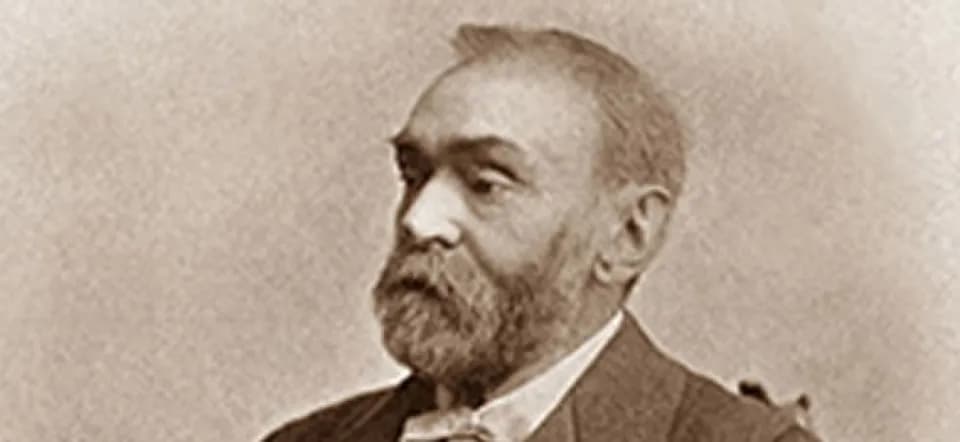
The highest—and above all the most prestigious—honor a scientist can receive today is the Nobel Prize. In his will, the Swedish scientist Alfred Nobel (1833–1896), inventor of dynamite and pictured above, bequeathed 32 million kronor (a fortune at the time!) to reward one or more scientists in physics, chemistry and medicine. Perhaps hoping to leave behind a favorable image, he also stipulated that prizes be awarded for literature and to someone working for world peace. Since 1901, these awards have thus brought leading scientists to prominence, and every nation takes pride whenever one of its own receives one. Yet there is one glaring omission: the oldest scientific discipline, on which most other sciences are based, has no place among these awards. The most farcical legends circulate about this. One of them has proved particularly persistent: Nobel's wife supposedly cheated on him with the Swedish mathematician Gösta Mittag-Leffler. There is just one major problem with the story: Nobel never married!
-
The Fields Medal
------------------
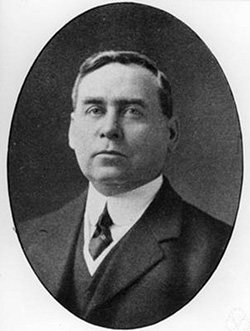
Faced with this conspicuous omission, the Canadian mathematician John Charles Fields proposed at the 1924 Toronto congress that a medal be created to reward young mathematicians (see Tangente 149). His aim was to support and recognize those who had already made major contributions. Yet the first two Fields Medals were not awarded until 1936, four years after his death, at the Oslo congress. The first committee was chaired by Francesco Severi and comprised Élie Cartan, George Birkhoff, Constantin Carathéodory and Teiji Takagi. It honored the Finnish mathematician Lars Valerian Ahlfors (1907–1996) for his research in function theory and the American Jesse Douglas (1897–1965) for solving Plateau's problem, which consists in finding the surface of least area bounded by a closed non-self-intersecting space curve. Interrupted by the war, the presentation of the medals resumed in 1950 at the Harvard congress, which honored the Frenchman Laurent Schwartz (1915–2002) and the Norwegian Atle Selberg (1917–2007).