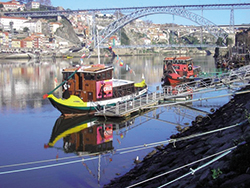
What if it all began with a film? In 1931, filmmaker Manoel de Oliveira (1908–2015) devoted his first film, Douro, faina fluvial, to his city. Porto is famous for its wines, its bridges and its river, the Douro, which the filmmaker called a "river of toil." To capture his city, he might have focused on the leading Portuguese and foreign figures in the wine trade. Instead, he shows the river's unsung workers, all those who helped, each in their own way, to give this place its distinctive soul. Another tangible presence in the short film is the Dom-Luiz Bridge (designed by Théophile Seyrig, a student of Gustave Eiffel), which spans the river and links the two separate parts of the port city. By focusing on the river's flow and the bridges above it, the filmmaker highlights the longitudinal and transverse movements that characterize the city and underpin its wealth.
A man and mathematics
-----------------------------
Francisco Gomes Teixeira was born in 1851 in São Cosmado, east of Porto, and died in Porto in 1933. He played an important role in bringing Portugal into the international mathematical community. His story shows that mathematics is the product not only of northern Europeans, but of southern Europeans too.
From 1869 to 1874, Gomes Teixeira studies at the University of Coimbra, then Portugal's only university. From the outset of his research, he is encouraged by Daniel Augusto da Silva (1814–1878), a professor at Lisbon's Escola Naval (Naval School). In 1875, he defends his thesis on the integration of second-order partial differential equations. He then teaches at the university. A corresponding member of the Royal Academy of Sciences of Lisbon, he becomes a full member in 1878. Silva convinces him of the importance of working to secure international recognition for Portuguese mathematics: Gomes Teixeira publishes papers in foreign journals and, in 1877, founds an international mathematical journal, the Jornal de sciencias mathematicas e astronomicas. After a brief spell at the Lisbon Astronomical Observatory, he is appointed professor at the University of Coimbra the following year and, in 1884, to the chair of differential and integral calculus at the Academia Politécnica de Porto. His teaching plays an important role in modernizing the way analysis is taught in Portugal. He also maintains an extensive correspondence with many European scholars, including the Italians Giuseppe Peano and Tullio Levi-Civita, the Frenchman Charles Hermite and the Swede Gösta Mittag-Leffler…