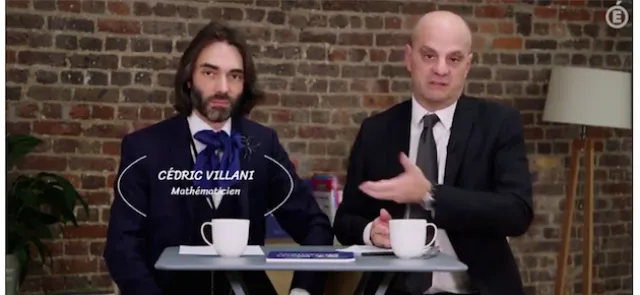
Judging by the international TIMSS and PISA assessments, mathematics teaching in France appears to be in trouble: for several years now, the country has remained near the bottom of the rankings. Jean-Michel Blanquer, Minister of National Education, asked the mathematicians Charles Torossian, an inspector general of the French national education system, and Cédric Villani—undertaking his second major assignment after the AI task force, whose conclusions were due in April—to assess the reasons behind this situation and recommend measures to improve it. Tangente invited Charles Torossian, the driving force behind the task force, for an interview.
First, credit must be given for the professionalism with which the work was prepared and conducted—including an analysis of previous initiatives, such as the Kahane Commission, whose work began in 1999—and for the brisk pace maintained by the group. The letter commissioning the report was issued on October 23, 2017; the first meeting took place on November 9; and on February 9, 2018, the group completed a report that was submitted on February 12 under the title 21 Measures for Mathematics Teaching. The full 96-page report is available by clicking here.
The group's 21 "permanent" members—coincidentally, as many as the measures themselves—came from a wide range of backgrounds: teachers from primary school to higher education, school heads, inspectors, teacher trainers and civil servants from the national education system. The ministry partially relieved the participants of their usual duties for three months, but their schedules remained packed: every week, they spent two days preparing and reflecting, followed by three days meeting with the other commission members or hearing from 16 panels of specialists on specific topics and eight other groups representing stakeholders in education ("15 cross-cutting round tables").
Arithmetic, teacher training and the system
===========================================
The wording of the 21 recommended measures (see the Tangente website), grouped under five themes, varies considerably: some are very specific, while others express broad aspirations rather than spelling out how they should be put into practice. The commission's proposals call for major initiatives in three broad areas: the place of arithmetic, the training of primary-school teachers and the adaptation of the system to the new landscape. The report will mean something only if these initiatives are actually undertaken! Let us begin with arithmetic.
Charles Torossian: "We need to take the politics out of learning arithmetic. Arithmetic is integral to mathematics: it is an essential stepping stone towards seeing and understanding the world around us. Did you know that fewer than 50% of middle-school students can multiply 35.1 by 100? Unacceptable! Our conclusion is that decimals and fractions must be introduced earlier…"
The press seized on the recommendation to use the Singapore method (see box) when introducing arithmetic operations. Although the published measures mention it only as an example, the recommendation was lent weight by the presence on the commission of Dorothée Badinier and Monica Neagoy, who publish its controversial French version through Librairie des écoles. This might be regarded as a conflict of interest, a charge that Charles Torossian rejects in view of the commission's size and, above all, the stature of its members. In practice, several alternative teaching approaches—including Montessori, which inspired the Singapore method—were considered during the hearings and round tables. France is, moreover, renowned for the quality of the intellectuals who have studied education, including Ferdinand Buisson, Célestin Freinet and Élise Freinet. Yet countries such as Singapore and Finland have so far been the ones to adopt these approaches, leaving us behind with their teaching methods.
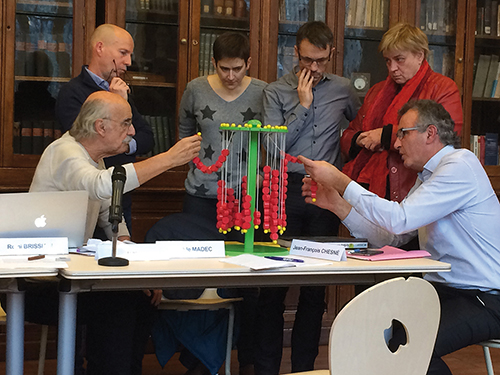
Rémi Brissiaud (left) and Jean-François Chesné (right) discover Hervé le Madec's "cherry tree," with le Madec standing at left and task-force members Anne Keller, Olivier Pinson and Michèle Deschler looking on.
Primary-school teachers
=======================
Naturally, these methods need to be applied from primary school onwards. But there is a longstanding and unmistakable problem: few people with a scientific background choose to become primary-school teachers. Far more seriously, primary teachers have often struggled with mathematics themselves. How, then, can we expect them to convey approaches that will help their students grasp mathematical concepts?
Charles Torossian: "This is the second major focus of our report. We propose a three-stage 'reconciliation module.' The first stage concerns how future primary-school teachers will experience mathematics in high school. I will return to that. The second takes place at university during their undergraduate degree. They will be offered additional courses, facilitated by the new higher-education landscape: we must take advantage of university groupings and the physical convergence of science and humanities faculties. The third and final stage is continuing professional development. We recommend 'horizontal' training among peers. The team is the basic unit. Everyone must move forward together, drawing on each person's skills. Nearly 1,200 educational adviser posts will be created to organize this horizontal training: their role will be more that of educational advisers than designated points of contact."
That final sentence offers a glimpse of the third focus: adapting the system to new realities. This is the hardest part. How can every level of the national education system be persuaded to change its methods? From the regional education authorities to classroom teachers, via inspectors and school heads, everyone will be affected by the recommended measures.
Charles Torossian: "A school built on trust must also stop directing its efforts exclusively towards students and attend to the teachers we trust as well: they are professionals. We will ask them to leave their classrooms to work in networks, embrace a plurality of approaches and create genuine mathematics learning laboratories where they can work together, with input from outside bodies (IREM, universities, CNRS…) before inviting students in. But of course, to make this happen, school heads must incorporate the strategic goal of reclaiming mathematics into the way their schools operate. They must facilitate the joint leadership of teams, adjust timetables, and fund initiatives and the additional time teachers spend on them… To test its feasibility, a three-year pilot scheme will be launched in five high schools."
Behind this focus, which changes the habits of everyone involved in the system, lies a genuine revolution in thinking: placing greater trust in students, abandoning the belief that they cannot learn, and no longer associating the word "elitism" with every horror in the world (see box).
Charles Torossian: "Every student can be motivated; the system must stop demotivating them. The way a lesson is taught must respect children's intuition and elicit a response from them. A more structured written lesson, better organized over the course of the session, is essential, but it is not enough. We must reconcile motivation, enjoyment, effort and independent work. The teacher's role will remain central."
Tangente can only endorse the commission's conclusions, even if we do not necessarily agree with all its recommendations. We can only hope that political leaders do not treat it as a mere publicity exercise, as the previous minister's "Mathematics Strategy" proved to be, and that it leads to concrete action. Yet the high-school reform announced a few days after the commission's measures came as a rude awakening: it confirmed that students could take the baccalauréat without any mathematics education during their final two years.
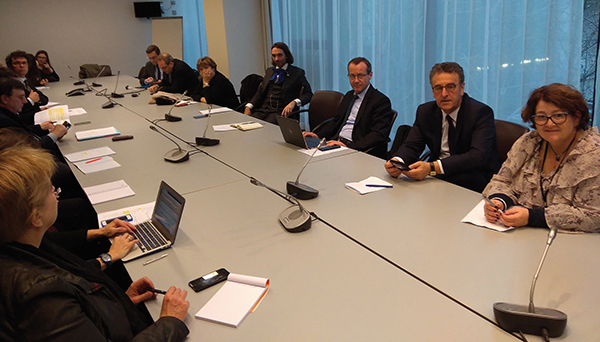
Wednesday, January 24: presentation of the report to members of Parliament at the National Assembly.