But the reform was still a long way off, and everyone preferred to look on the bright side. Yet an editorial in issue 181 of Tangente, published in March and featuring an interview with Charles Torossian, should have sounded the alarm: "No to the No Mathematics option!"
A year later, the disastrous nature of this reform is finally being recognized. Contrary to Cédric Villani's claims in two recent videos alongside Minister Jean-Michel Blanquer, the reform allows students to stop training their minds in mathematical reasoning and will ultimately weaken the one skill that could have enabled the French economy to meet its challenges and unemployment to fall—especially since mathematics teaching hours have also been drastically reduced in vocational education.
Alice Ernoult, president of the APMEP (Association des professeurs de mathématiques) and a member of the Villani–Torossian task force, is publishing an article in the next issue of Au fil des maths whose title speaks for itself: In Search of the Missing Mathematics. It is a restrained article—professional discretion demands it, a requirement recently tightened by the Minister of National Education, though one wonders why—that draws attention to the risks posed by this reform.
But why introduce such a reform when the need for scientific education was thought to command unanimous support? One rumor is circulating about the origin of these measures: the alarming decline in the number of mathematics teachers. Do those in charge not realize that they are embarking on a vicious circle? The less mathematical education students receive, the fewer candidates there will be to teach the subject! Wouldn't it be wiser, for example, to pay mathematics teachers more? Yes, I know, what an outrageous suggestion…
Video versus video
==================
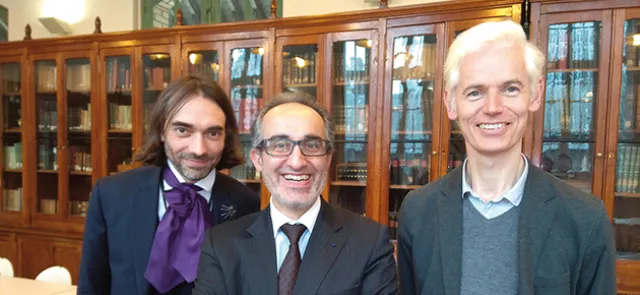
On January 8, Jean-Michel Blanquer and Cédric Villani published two videos on the Ministry of National Education website about the value of mathematics and its role in the high school reform. The first, entitled "A New Mathematical Ambition for Schools," consists of general observations about what mathematics can contribute to education. In particular, the speakers point out that a great deal is determined in primary school and emphasize teacher training. So far, there is little to disagree with.
The second video, "Mathematics at the Heart of the New High School," is considerably more contentious. It opens with a statement by Jean-Michel Blanquer: "Mathematics will benefit greatly from the high school reform."Yet each subsequent claim seems to rest on nothing more than flimsy arguments.
"The presence of mathematics in tenth grade is essential": he justifies this with… the placement tests in mathematics and French at the beginning of tenth grade. Cédric Villani then discusses the "new general science course", in which, without batting an eyelid, he explains that mathematics appears… only through applications in the context of other subjects.
They then show that, by choosing every available option, students could take nine hours of mathematics a week in their final year of high school, and that anyone wishing to study life and earth sciences or medicine without having taken mathematics earlier could still attend an additional three-hour course in that final year. The case of students who chose languages or history is not even mentioned: one has to wonder how future candidates for primary-school teaching posts will be prepared… And they conclude: "Not everyone needs to take nine hours of mathematics in their final year of high school. The point is not to do less, but to do it better." Better with nothing?
Needless to say, the arguments do not hold up. Yvan Monka, a teacher and "YouTuber" whose site, **www.maths-et-tiques.fr*, attracts a great many visitors, responds to the minister's claim in a video highlighted on Dailymotion by the APMEP and les Dernières Nouvelles d’Alsace*.