From 1994 to 2019, the general high-school track was divided into three streams from the penultimate year onward: S (science), ES (economics and social sciences) and L (literature). Each had its own curriculum and specializations. The following graph shows how many hours of mathematics teaching students received in the penultimate and final years, depending on their chosen stream.
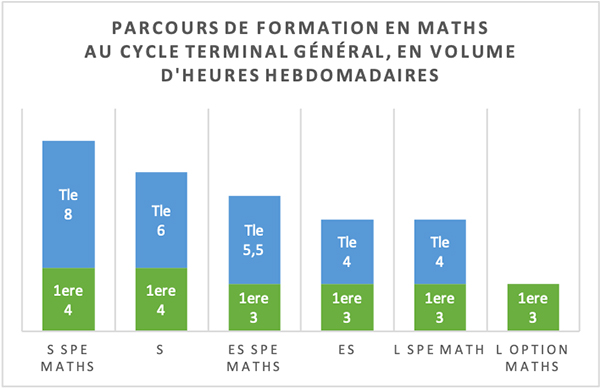
From 1994 onward, the proportion of students in the S stream, which tended to be seen as a generalist stream, rose steadily. In 2019, 52% of final-year students at general high schools followed the S curriculum, with six hours of maths per week; one-quarter of them also took the mathematics specialization, bringing their weekly total to eight hours.

The maths specialization (5.5 hours/week) was taken by about 50% of ES students, who otherwise had four hours of maths per week, as well as by 10% of L students. Thus, in the final year before the reform, about 87% of students continued studying maths through their final year of high school.
The planned disappearance of mathematics from education
---------------------------------------------------------------
At the start of the 2019 school year, a reform completely restructured the general and technological high-school tracks. It was implemented at the request of Minister of National Education Jean-Michel Blanquer, following Pierre Mathiot's proposal, and reflected the plans of French President Emmanuel Macron.
In what is known as the upper secondary cycle of the general track, comprising the penultimate and final years, the reform abolished both the concept of a "stream" and even that of a fixed class group. It brought an end to a stable, long-established system dating back to the 1960s.
Since 2019, mathematics has disappeared from the common core and become entirely optional. The only compulsory subject in the penultimate and final years is a broad two-hour-per-week science course covering biology, physics and chemistry, together with a few mathematical concepts related to those subjects.
Of the thirteen specializations available in the penultimate year, each taught for four hours per week and each student being required to take three, only one is devoted to mathematics. Everyone who chooses it therefore receives the same course, regardless of their academic profile, plans for further study or enthusiasm for the subject.
In their final year, students retain only two of their specializations in the standard curriculum, with the time allocated to each rising to six hours per week. Three additional options, each taught for three hours per week, are also available. They have a special status under which the final mark counts toward the baccalauréat average; two of them concern mathematics.
Both are optional and available only to students who took the maths specialization in the penultimate year:
• The advanced maths option (ME), essential for scientific preparatory classes for the grandes écoles—for example, complex numbers are covered only here—is available only to students who retain the maths specialization in their final year,
• The complementary maths option (MC), which is organized more around themes, is available only to students who drop the maths specialization in their final year.
These options are not necessarily offered at every school.
A quick calculation based on data from the Ministry of National Education's Direction de l’évaluation, de la prospective et de la performance (DEPP) shows how final-year students were distributed in 2019 and 2021 according to the number of hours of mathematics offered to them each week, from zero to nine.
While about 87% of students studied maths in both the penultimate and final years in 2019, only 64% did so in the penultimate year after the reform. The figure then fell to 37.5% once students dropped the maths specialization, or 55% when the MC option is included.

A major impact on girls' education
-------------------------------------------------
Girls outnumber boys in general high schools, accounting for 56% of all students, and achieve better results: in every stream, their baccalauréat pass rate is two to three percentage points higher than that of boys.
Their distribution among the streams was uneven: in the upper secondary cycle in 2019, girls were underrepresented in S (47.5%), slightly overrepresented in ES (60.7%) and heavily overrepresented in L (79%).
For many reasons, the number of girls in the S stream rose steadily between 1994 and 2019.
In the final year before the reform, about 83% of girls studied mathematics in the penultimate year and 82% in the final year.
After the reform, the only mathematics course available provided training suited to the science-oriented profiles of the former S stream. It was therefore difficult for students with less clearly defined profiles, or those oriented toward economics and social sciences—the former ES stream—to take. Yet most of these students were girls. With no suitable course available, they stopped studying mathematics, causing the proportion of girls in mathematics to fall.

In 2021, only 55% of girls chose the maths specialization in the penultimate year; by the final year, the proportion of girls studying maths had fallen to 45%. Compare that with 82% before the reform…

A large-scale systemic failure
--------------------------------------------
The system now in place raises questions for the future: how independent will these future adults be without a high-school-level grounding in mathematics? What confidence can we have in future primary-school teachers' ability to pass on mathematics? Where will the scientific talent needed to prepare tomorrow's society come from? What place will there be for girls? What about social mobility into highly valued scientific careers arising from mathematics or computer-science pathways (STEM)?
There is an urgent need to reverse the measures that are having such consequences for young people's education and that result largely from structures chosen to reduce training costs. There is reason to fear that these short-term cuts will ultimately prove far more costly to society over the coming decade.
No superficial treatment of the problem can provide a genuine solution. Only the rapid creation of working groups involving qualified practitioners in the field, committed to a thorough reconsideration of how high school should be redesigned, could correct by the start of the 2023 school year what amounts to a large-scale systemic failure.