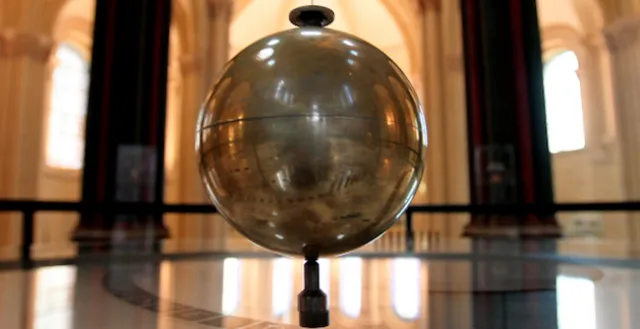
Where to begin? That was probably the question visitors asked themselves, sometimes frustrated that they could not enjoy all the activities taking place at the same time. Had Club Tangente, the association organizing the event, been too ambitious? Let us explore this magnificent, labyrinthine museum.
The church: a haven for mathematics devotees
------------------------------------------------
Did someone say "labyrinth"? That gives us the perfect opportunity to begin with the art exhibitions held throughout the day in the church apse, on the museum's ground floor. Mathematical art took pride of place, with works by six artists on display. Readers familiar with the Tangente Awards will already know four of them: as in previous years, they created the trophies or special-mention certificates presented to the winners (you can see their creations in the article "The 2022 Tangente Awards ceremony"). They are Denise Pranville, Patrice Jeener, Scowcza (the duo formed by Pierre SChmitt and Dominique OWCZArski) and Gilles Fernandez (also known as Sellig Zed). Works by two other artists were displayed in the apse: Sandrine Vivier-Souder and France de Ranchin, a creator of… labyrinths!
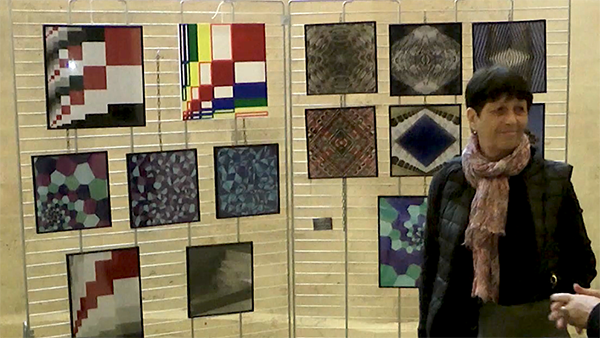
Denise Demaret-Pranville presenting her work.
The church also hosted another of the subjects explored in Tangente's "connections" section, alongside art: literature. From 11:30 a.m. to 4 p.m., authors—including, of course, those attending as winners or recipients of special mentions in the Tangente Book Prize and the Tangente High School Students' Book Prize (PTL)—took turns giving short presentations of their books in the Chapel Tower. Each mini-talk was followed by a book signing outside the room. The church was also home to the "Tangente bookshop," whose tables drew a steady stream of visitors throughout the day and offered the latest mathematical bestsellers.
Talks and workshops for everyone
-------------------------------------------------
But mini-talks were not the only attraction! Nine speakers gave 45-minute talks throughout the day at three main venues: the Abbé-Grégoire lecture theatre, the conference room and, on the first floor, the communication workshop.
Gilles Cohen opened the day with a look back at Tangente's history. Another key figure from the magazine's earliest days was also there: Joseph Césaro, who had travelled from Valbonne in the Alpes-Maritimes, the French Riviera town of which he is mayor. The major milestones in the magazine's 35-year history were recalled, particularly the great turning point in 2000, when the decision was made to risk distributing it through newsstands.
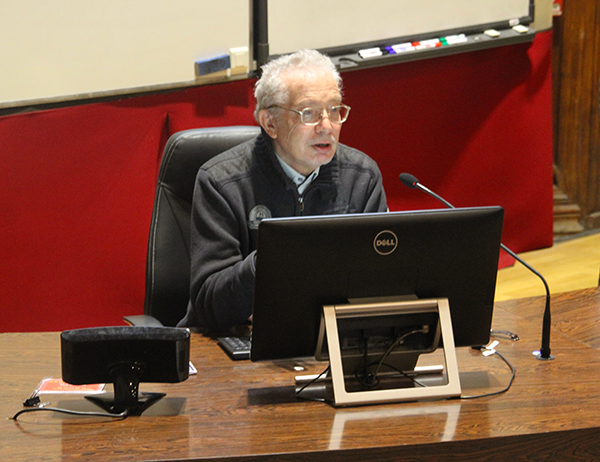
Jean-Paul Delahaye during his talk.
The day's talks covered a wide range of subjects and levels. Daniel Justens discussed mathematical models in Midam's comic strips; Jean-Paul Delahaye, "one-way functions"; Roger Mansuy, the little-known mathematician Charlotte Angas Scott; André Deledicq, "words and maths," using words chosen by the audience; Gilles Godefroy and Bernard Randé, René Baire and functional analysis; Mohamed Mesmoudi and Lydie El-Halougi, from the Les maths en scène association, "sound, the sculptor of forms"; Marc Thierry, a topic featured in this issue: sangaku; and Dominique Souder, naturally, magic, in a talk entitled "Calculating prodigy or clever mathemagician."
As one might expect, Dominique Souder did not stop at giving a talk. Together with his son Pascal-Yves, he ran a highly successful magic workshop for much of the day. Similarly, the team from the Les maths en scène association devoted an area to "amazing mathematics." The workshops, most often run by associations, occupied the museum's entire first and second floors.
Mathematical and board games made up most of the activities on offer. The CIJM (International Committee for Mathematical Games), for example, devoted its workshop to Hex (with Marie José Pestel), while board-game federations, including those for bridge and go, explored how their respective games could be used to teach mathematics. The FFJM (French Federation of Mathematical Games), whose president, Michel Criton, oversees Tangente's mathematical-games sections, ran two workshops: one focused on problems set over the past 35 years in the International Championship of Mathematical Games, and the other on logic-grid puzzles.
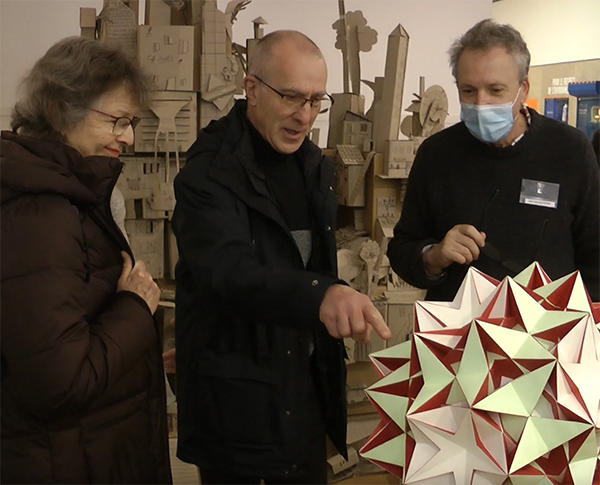
Jean-Jacques Dupas discussing the construction of a polyhedron.
The other focus of the workshops was geometry. This included the polyhedra workshop run by the PlayMaths association, in which two Tangente authors, Jean-Jacques Dupas and François Lavallou, also play an active role, as well as the tiling and origami workshops organized by the Science Ouverte association.
Activities that stood out
------------------------------
The same Science Ouverte team, led by François Gaudel, spent the entire day coordinating the collective construction of a giant structure—a tensegrity tower. One hundred and fifty people helped build it. It was one of the original activities that attracted large numbers of visitors, who found themselves torn between all the day's exciting offerings.
####
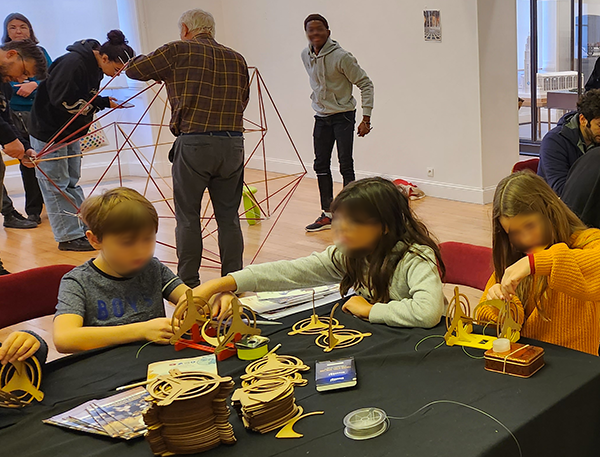
Science Ouverte's collective construction project and workshops.
Another hugely successful activity was the scavenger hunt organized by Brigitte Bourgasser-Wenner and Audrey Candeloro. Equipped with a puzzle booklet and a UV flashlight, visitors had to explore part of the museum in search of additional clues written in invisible ink on some ten A3 posters scattered around a dimly lit area. The clues were revealed using the special flashlight supplied to participants. A group of around ten people set off every fifteen minutes on an adventure lasting between 45 minutes and one hour at most, allowing up to 40 people to take part simultaneously. This gave the activity a capacity of 120 participants over its three-hour run—a figure that was very nearly reached.
The exhibition "Mathématiques, informatique… avec elles," created by the Femmes et mathématiques association, was due to go on public display. A transport problem—not the only one that day, as preparations had been disrupted by an SNCF strike—prevented it from arriving. No matter! A digital version projected onto a screen allowed visitors to explore the exhibition as though it were really there. Several members of the association attended, even giving talks at 11:30 a.m. and 2:30 p.m. to comment on the exhibition. As an added bonus, one of the twenty women mathematicians featured in it, Aurélie Le Cain, who is responsible for smart glasses at Essilor and holds a doctorate in applied mathematics, joined them for part of the day.
Another important event was the "teachers' meeting," held from 11:30 a.m. to 1 p.m. Following an introduction by Karim Zayana, an inspector general who has supported Club Tangente's activities for several years, a number of speakers—most of them involved in the day's workshops—presented the attending teachers with activities suitable for use in middle or high school. Alice Ernoult began by discussing Litteramath, a joint initiative by Club Tangente and the APMEP (association of mathematics teachers), in partnership with the IREM network and Publimath, which lists, level by level, all published books about mathematics that can be recommended to students. Martine Brilleaud then spoke about the quarterly *Tangente Éducation*, aimed at mathematics teachers. She went on to explain how the Tangente High School Students' Book Prize works: every year, more than 600 students vote at their high schools for their favorite among the shortlisted books. Michel Criton then described the International Championship of Mathematical Games; Albert Fenech emphasized the value of go in the mathematics classroom, as did Jean-Pierre Geneslay for bridge and Nicolas Pelay for Hex. Marie Lhuissier, a mathematician and storyteller, brought the meeting to a close by presenting her new show for primary and middle school pupils.
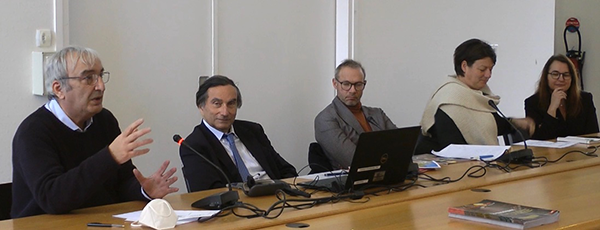
From left to right: Albert Fenech during his presentation, Gilles Cohen,
Karim Zayana, Alice Ernoult and Martine Brilleaud.
And there were shows, too…
----------------------
Oh yes! There were two shows—one of them performed twice—and, like all the day's events, both were free to attend.
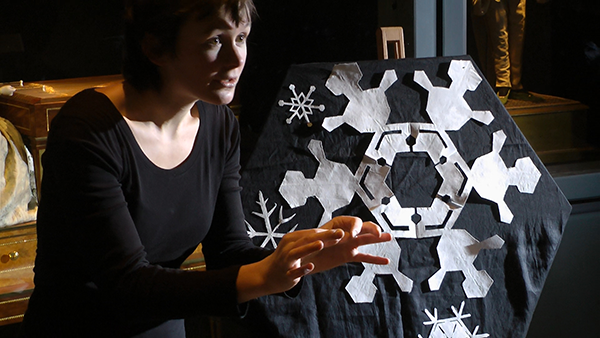
Marie Lhuissier telling her story.
The first, performed twice, was Marie Lhuissier's "La faiseuse de neige." As a child, Marie loved stories, puppets and songs. Then she discovered mathematics and found it beautiful, so she followed it for a while. After qualifying to teach and earning a doctorate in mathematics, she eventually decided to renew her friendship with her old companions: stories. She is now a mathematician and storyteller: she invents, writes and tells stories—but mathematical stories! In 2022, Marie Lhuissier received the Société mathématique de France's D’Alembert Prize for her mathematical tales.
The second show, "Les Indécis," a statistical cabaret produced by the Terraquée company, is deliberately multifaceted. It currently consists of two acts lasting around twenty minutes each, in which three comic characters—the main one played by François Perrin—ask: "What is a decision based on numbers?"
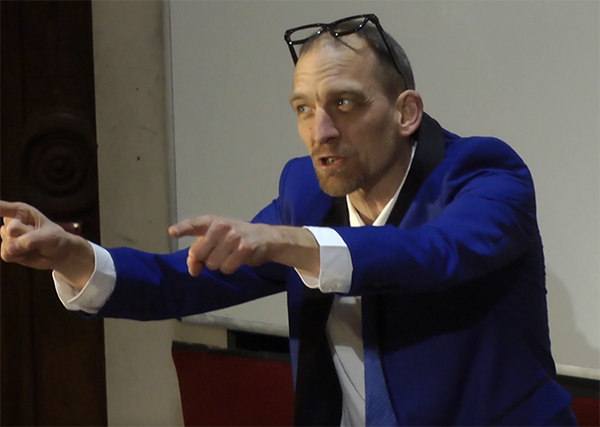
François Perrin on stage.
This show also captivated the audience—the lecture theatre was packed. It began at 4 p.m., at the same time as the Tangente Awards ceremony (see the article "The 2022 Tangente Awards ceremony"). Choosing is hard! Audience members said they were delighted, but admitted that they had faced dilemmas like this throughout this activity-packed (perhaps overly so?) day.
Our thanks to the FSMP, the Fondation Blaise Pascal and the Fondation Hadamard for their support in organizing this event.