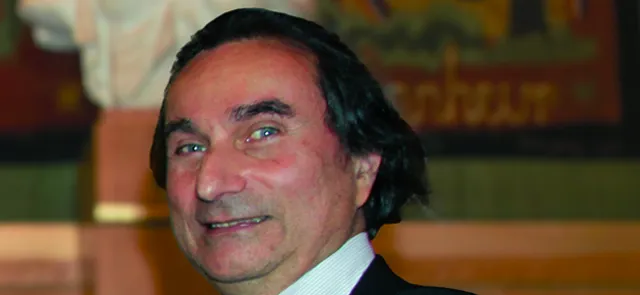
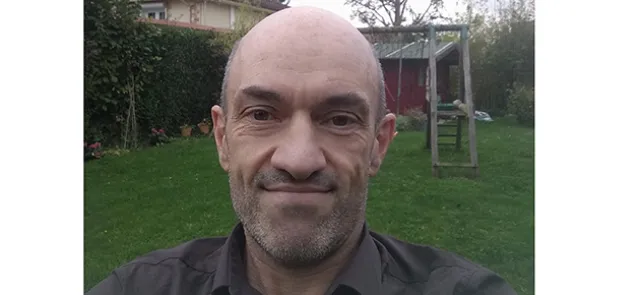
The pairing of the words "culture" and "mathematics" may strike many people as incongruous. Yet discovering Tangente was a revelation for some, including Fabien Durand, president of the Société mathématique de France, who puts it this way:
"I discovered Tangente at the beginning of 1988, when issue 2 came out. I was then a student at the Université de Reims, preparing for something entirely different from studying mathematics. Mathematics did not frighten me, although I felt I had not fully mastered it. Around the time I was reading that second issue, I happened upon Douglas Hofstadter's book Gödel, Escher, Bach: An Eternal Golden Braid (InterÉditions, 1987). Reading the two at the same time sparked a powerful enthusiasm and a total commitment on my part to studying mathematics at university."
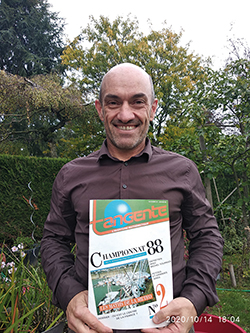
Fabien Durand proudly displaying his copy of issue 2 of Tangente.
An encounter, an adventure, a passion
----------------------------------------
For Fabien Durand, as for others, this marked the beginning of an adventure that continues to this day. Have you noticed that "The Mathematical Adventure" is Tangente's subtitle? It truly was an adventure for the famous and unsung alike who chose to devote their lives to mathematics, whether studying it or bringing it to a wider audience. They include the many authors who regularly put pen to paper—or rather, fingers to keyboard—to write articles for our pages, much to our readers' delight, and even books that are reaching an ever-wider readership through bookshops.
For them, it became a passion, as it did for Stella Baruk, whose passion predated the founding of Tangente but who was delighted to join our team.
"When you own issue 1 of Tangente, bought one day in the autumn of 1987—for 25 francs, ah, the nostalgia—a magazine bold enough to advertise the risk it was taking with the subtitle L'aventure mathématique*, seeing its 200th issue arrive cannot help but stir both emotion and admiration. Mathematics, on glossy paper, presented differently from the way it appears in mathematics books—but mathematics all the same! It could only arouse my curiosity, along with the hope that, besides the discoveries I was bound to make, I might find answers to my students' perennial "What's it for?" —a question that had received only rather inadequate answers. A few issues later, I could venture a conjecture; today, on the threshold of the 200th, I can state the answer even more succinctly: "Everything!" "*
In these words, Stella Baruk describes how Tangente accompanied her for a third of a century in her unending quest to answer the question "How can we make people love mathematics?" (see her account in the box).

Manu Houdart during one of his performances. If you are going to the Avignon Theatre Festival, you can see Very Math Trip at the Théâtre des Lucioles
from July 7 to 31 at 5:30 p.m.
Manu Houdart, now famous for his breathtaking show "Very Math Trip," recalls the moment he fell in love:
"I remember the first time I came across the magazine Tangente very clearly: it was... in a black-and-white photocopy. My mathematics teacher wanted to share an article on conic sections with us! I was 17, and I thought it was brilliantly put together. Later, while studying for a mathematics degree, I could read the magazine in the university library, and as soon as I began teaching, I subscribed!
Today, it is an important source of information for me, and I often draw inspiration from it for my shows or my YouTube channel. In turn, the magazine helps people discover my work: audience members often tell me they came after seeing me listed in its events calendar. When I began writing my book, I definitely sometimes found myself—at the back of my mind—dreaming of the Prix Tangente! Today, that trophy, which I won in 2020, adorns my mantelpiece. Thank you, Tangente !"
A flowering of initiatives
---------------------------
From its very first issue, Tangente attracted many subscribers, showing that by the late 1980s there was a real appetite for a different approach to mathematics—one rooted in culture, history and games: in short, for enjoying oneself while doing mathematics.
There was also a need to dispel the disastrous image of mathematics left by the period known as "modern mathematics" (see Gilles Cohen's article on page 14).
In the years that followed, right up to the present day, many initiatives appeared with the same aim. Would they have come about if Tangente had never existed? If its team had not taken the risk of putting it on newsstands in 2000? Probably—but they would have developed more slowly and been fewer in number. The magazine regularly reported on all these events, often partnered with them and publicized them through its events calendar.
Conversely, many advocates of mathematical culture found not only inspiration but also the motivation to organize their own activities. In the last century, could anyone have imagined people enjoying themselves at mathematics festivals such as the "Culture et jeux mathématiques" fair; the "Maths en ville" and "Maths en scène" festivals; the "Fête à Fermat" in Beaumont-de-Lomagne; "Math'Gic" in Gennevilliers; "La Nuit des maths"; or the Grand Forum des mathématiques vivantes?
Mathematics rallies have also flourished, culminating in the creation of the Kangourou des mathématiques, which brings together hundreds of thousands of participants.
Every year, some thirty books related to mathematics—but neither textbooks nor specialist works—are published. Despite the difficulties of getting them into bookshops—independent booksellers are not always well informed—some have enjoyed considerable success. Examples include Le Théorème du perroquet by Denis Guedj (Le Seuil, 1998) and Le Grand Roman des maths by Mickaël Launay (Flammarion, 2016).
The creation of the Prix Tangente du livre in 2009, followed by the Prix Tangente des lycéens, helped showcase this literature and promote a different approach to mathematics. Authors and publishers alike now watch closely, since winning one of these awards can make a book's sales soar. Another ongoing initiative, Litteramath, jointly organized by Tangente and the APMEP, recommends books, classified by level, for school libraries to make available to students.
Let us leave the final word to Charles Torossian:
" Tangente is a model of bottom-up thinking. It shows that modern organizations are not merely top-down structures in which a few people isolated in a ministry provide the impetus and direction—although this is absolutely necessary when seeking to launch ambitious national policies, such as raising standards in mathematics. They must also know how to listen, bring grassroots initiatives together and enable them to be rolled out on a large scale."
Our thanks to all the prominent figures who contributed their accounts and are quoted in this article and the next.