"A few years ago, in response to one of my grant applications, officials at the Ministry of Culture told me that mathematics did not fall within the realm of culture and that I should approach the Ministry of Scientific Research. Mathematics was thus supposedly the exclusive preserve of science, with any possible links to culture being purely accidental, if not the result of some bureaucratic wrong turn. This misconception, which denies mathematics the cultural status it nevertheless fully possesses, is harmful in two ways: it confines mathematicians to a stultifying ghetto and deprives enthusiasts—whether knowledgeable or not—of a panoramic view of the world and the critical thinking needed to analyze the major issues of our time." Thus begins the editorial written by Gilles Cohen for Culture maths (Math Culture; Seuil, 2008), a collection of articles published in Tangente that set out to dispel this very misconception.
This quotation neatly sums up the common thread running through Gilles's tireless work to popularize mathematics, always with the same aim: to share his passion for the subject with as many people as possible. He stayed true to the course he had set for his life until his final day, leaving us on November 19 last year while preparations were under way for Journée Tangente, a major celebration of mathematics held at the Musée des Arts et Métiers in Paris. The event did go ahead—thanks to the efforts of his friends and colleagues—less festive than planned, but just as engaging as ever.
From mind games to mathematical games
-------------------------------------------
Gilles began publishing at a fairly young age. His first books, published with Gérard Cornuéjols by Hatier in 1974, were collections of mathematics problems with solutions for science-track students in their final year of high school and for students in the first years of university. At the time, he was still a student at the École normale de Saint-Cloud, which he had entered at the age of 18. The first part of his life was devoted to mind games, particularly bridge (see box).
Alongside his teaching career—mainly in France's post-secondary preparatory classes, particularly at Lycée Saint-Louis in Paris, where he taught for twenty-two years, from 1983 to 2005—he contributed to several magazines: Pleins Jeux magazine, Jeux et Stratégie, Science et Vie, La Recherche…
In 1986, he edited Le Livre des jeux (The Book of Games; Bordas), an expanded translation of Peter Arnold's The Book of Games (Golden Press, 1985). He then began founding his own games magazines, initially through the company Jeu Espace Temps, which began publishing Jouer à tout in 1991, along with its sister publications Jouer Bridge, Jouer Échecs and Jouer Jeux mathématiques.
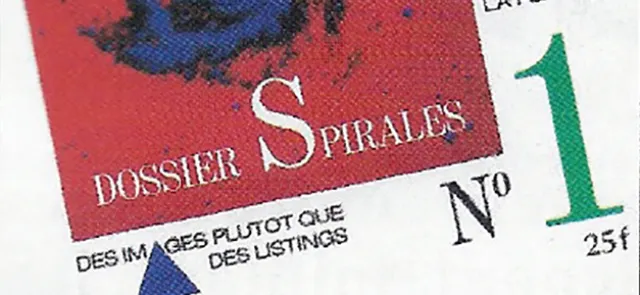
His longest-running collaboration was with Le Monde, where from 1997 he wrote a weekly mathematical games column with Élisabeth Busser; Jean-Louis Legrand joined the pair in 2017. Problem No. 1 is reproduced in In Brief, the "Affaire de logique" column.
Games: a gateway to mathematics
----------------------------------------------
1987 was a special year for the readers of Tangente. It was the year their favorite magazine was founded by enthusiasts dedicated to popularizing mathematics. The first issue appeared in October, with Jean-Pierre Boudine as editor-in-chief.
Among the founding partners was the newly established Fédération française des jeux mathématiques (FFJM), chaired by Gilles Cohen. Convinced that games provide a gateway to mathematics and that competitions offer students valuable stimulation and motivation, Gilles founded both the French Mathematical and Logical Games Championship and the FFJM, the body responsible for organizing it, in 1987. Open to all middle- and high-school students, with an "open" category for the general public, the championship was a success, attracting nearly 50,000 participants. It soon became an international championship and spread to other countries, where qualifying rounds were organized. Several mathematical games federations were founded—in Belgium, Switzerland, Italy and Tunisia…
Gilles chaired the FFJM from 1987 to 1993, before handing over to Michel Criton. Soon afterward, he and the FFJM team created the Université mathématique d'été (UME), which organized week-long mathematics camps for young people during the summer holidays. Offered from 1991 to 2003, these summer programs inspired many participants to pursue mathematics.
As federations for mathematical games and mathematics competitions proliferated, Gilles became convinced that a shared organization was needed to pool their energies. Thus, in 1993, the Comité international des jeux mathématiques (CIJM) was born—a "federation of federations" whose motto was "Together we are stronger in inspiring a love of mathematics." Gilles served as its president until 2001, when Marie José Pestel took over. It was within this organization that Gilles's great project came to fruition: a fair devoted entirely to mathematics. This became the annual Culture et Jeux mathématiques fair in Paris, which, when the weather is favorable, attracts up to 10,000 visitors over its four days of festivities.
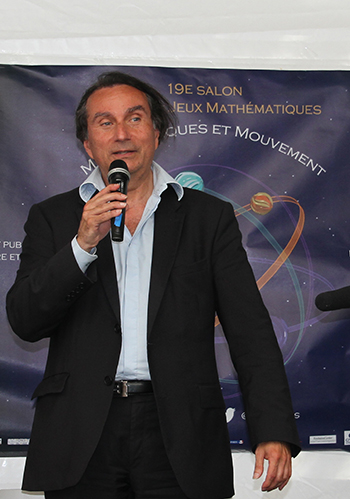
Gilles Cohen in 2018.
The Éditions POLE story
-----------------------------
Let's return to 1987 and the founding of Tangente magazine at Éditions Archimède. A member of the editorial team from the very first issue, Gilles became editor-in-chief in 1996. He then planned to take the magazine beyond the school market, where it was sold by subscription, and put it on newsstands for the general public. Unfortunately, he was the only one who believed in the idea; to make his project a reality, he had to buy the title from his partners. Éditions POLE completed the purchase in 2001. The name had nothing to do with conic sections: POLE was an acronym for "Production et organisation du loisir éducatif." Founded in 1990—with Gilles now alone at the helm—the company initially produced a television program about… mathematics. Also called "Tangente," it consisted of seven episodes broadcast on FR3, now France 3, in 1990–1991. Gilles also hosted a weekly France Culture radio program, "Épreuve par neuf."
Éditions POLE was soon operating at full tilt, publishing numerous books on mathematical games, chess, bridge and other mind games. Some magazines were acquired and relaunched—Tangente jeux et stratégie (2002–2007), Jouer Bridge and Spécial logique—while others were created: Sciences et Info prépas in 1998, which became Tangente Sup from issue 21 onward, with Hervé Lehning as editor-in-chief; Énigma X for ages 9–13 in 2005; Tangente Éducation; the special issues of Tangente; and the celebrated "Bibliothèque Tangente" series, available at all good bookstores with a science section…
Gilles even drew on the teachers among his editorial staff to create a series of school textbooks which, regrettably, did not achieve the hoped-for success.
Following the failure of the "Aventure Maths" textbook series, Éditions POLE experienced its ups and downs but stayed the course and weathered the storm—a press distributor's bankruptcy, the Covid-19 pandemic and soaring paper prices—thanks to its loyal readership. In 2018, Gilles decided to retire and devote himself to other projects especially close to his heart, always for the benefit of others and always centered on games and mathematics, notably through Club Tangente, a nonprofit association governed by France's 1901 law. He helped organize events including the Trophées Tangente (see "The 2023 Trophées Tangente winners"), Journée Tangente and the Affaire de logique competition… He entrusted Martine Brilleaud with overseeing the editorial team while continuing to handle Éditions POLE's administration. He also continued to write articles and edit special issues on subjects dear to him: La Recherche opérationnelle (Operations Research; Bibliothèque Tangente 75, 2021)—his university research topic—and, of course, Mathématiques et Jeux de société (Mathematics and Board Games; Bibliothèque Tangente 83, 2023).
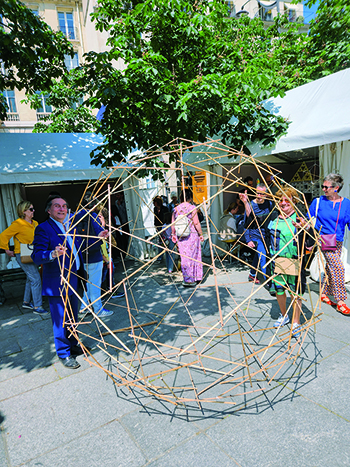
Gilles Cohen and Marie José Pestel at the Culture et Jeux mathématiques fair in 2023,
Place Saint-Sulpice, Paris.