Cryptarithms
-------------
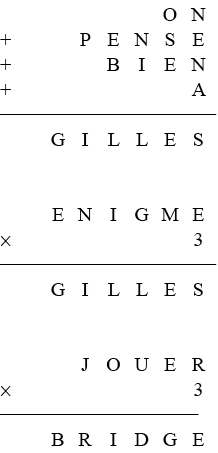
As with any cryptarithm, the task is to solve this sum, in which two letters represent two different digits and no number begins with zero.
The mischievous friends
-------------------
Estelle and Chloé are fans of mathematical puzzles.
1. One day, Estelle sends Chloé the following message: "Here are five numbers: 346, 905, 376, 845 and 305. My favorite number has three digits, and each of the five numbers has exactly one digit in the same position as in my favorite number."
What is Estelle's favorite number?
2. A few days later, Chloé sends Estelle a note: "I hope you can come to my birthday party. Here are eight numbers: 4,358, 1,026, 7,944, 3,817, 4,659, 2,751, 8,903 and 5,227. The entry code for my building has been changed. It is a four-digit number, and each of the eight numbers has exactly one digit in the same position as in my building's entry code."
What is the entry code for Chloé's building?
The pigeonhole principle: think tangents!
---------------------------------------------
Try solving this seemingly harmless little combinatorial puzzle: prove that every set E of five real numbers contains two numbers, a and b, such that .
The usual techniques of arithmetic, combinatorics and analysis will not solve this innocent-looking question straight away. So think of making a change of variable!
**Solution**
Bertrand's paradox
-----------------------
There are three identical boxes. The first contains two green marbles, the second one green marble and one red marble, and the third two red marbles. One of the boxes is chosen at random (with equal probabilities), and then one of its two marbles is chosen at random (again with equal probabilities).
1. If the marble drawn is found to be red, what is the probability that the other marble in the same box is red?
This time there are n + 1 boxes, each containing n marbles (with n ≥ 2). For 0 ≤ k ≤ n, box number k contains k red marbles and n − k green marbles. As before, one of the boxes is chosen at random, followed by one of the marbles in that box (with all choices equally likely each time).
2. Given that the marble drawn is red, a second marble is drawn at random from the same box (without replacing the first). What is the probability that it is red?
Solution**
Three collinear points?
----------------------
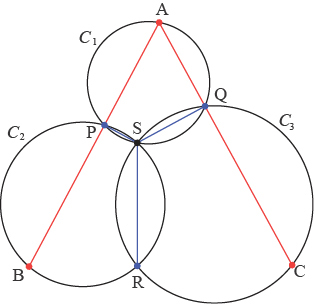
The three circles C1, C2, C3 all pass through S. The circles C1, C2 meet again at P, the circles C1, C3 meet again at Q, and the circles C2, C3 meet again at R. Choose a point A (distinct from P and Q) on the circle C1. Line AP meets the circle C2 again at B, and line AQ meets the circle C3 again at C.
The points B, R and C appear to be collinear. Is this true?
**Solution**
Three plots of land
----------------------
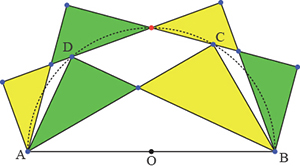
Alice and Bob each own three plots of land shaped like right triangles. The points C and D lie on the semicircle with diameter AB. Isosceles right triangles have been constructed on segments AD, DB, AC and CB. The total area of Alice's land (in yellow) appears to equal that of Bob's land (in green).
If it does, prove it! If it does not, prove that!
**Solution**
Three vases
-----------
Alice proposes the following game to Bob: she sets out three vases, called A, B and C. She places thirteen counters in vase A, fifteen in vase B and seventeen in vase C. At each step, Bob chooses two vases that each contain at least one counter, removes one counter from each of them and places both counters in the third vase. The aim is to empty two of the vases, leaving all the counters in a single vase.
Can Bob achieve this goal? If so, what is the minimum number of steps required?
**Solution**
Adjacency problems
----------------------
Consider a row of cells numbered from 1 to n.
1. Two cells i and j are neighbors if | i – j | = 1. We want to color these cells black (N) or white (B) so that every N cell has exactly two neighboring B cells and every B cell has exactly one neighboring N cell. For which values of n is this possible?
2. We now extend the definition of "neighbor": two cells i and j are "neighbors" if | i – j | ≤ 2. We want to color these cells black (N) or white (B) so that every N cell has either two or four neighboring B cells and every B cell has either one or three neighboring N cells. For which values of n is this possible?
Dividing a triangle into two regions of equal area
------------------------------------------------------
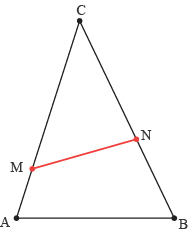
Place a point M on side AC of triangle ABC, "closer" to A than to C. Devise several methods for finding the point N on side BC such that segment MN divides triangle ABC into two regions of equal area.
The solutions to the problems on this page, together with the full accounts from Gilles's friends, can be found in the digital edition of this issue at **tangente-mag.com**.