Defining dimension: not so simple…
-------------------------------------
According to Euclid, an object's dimension is the number of parameters needed to describe it: a line has dimension 1, while a plane has dimension 2. The introduction of coordinates, following Descartes's work in the 17th century, made this idea concrete.
Curves and surfaces also have a dimension. A classical curve, such as a circle, parabola or sine curve, is quite clearly a one-dimensional object. Once an origin and a unit of length have been chosen, any point on it can be represented by a single parameter: its arc length. On a sphere, two parameters locate any point: longitude and latitude, which are used to specify a location on the Earth's surface. A sphere therefore has dimension 2, while the ball—the interior of the sphere—has dimension 3.
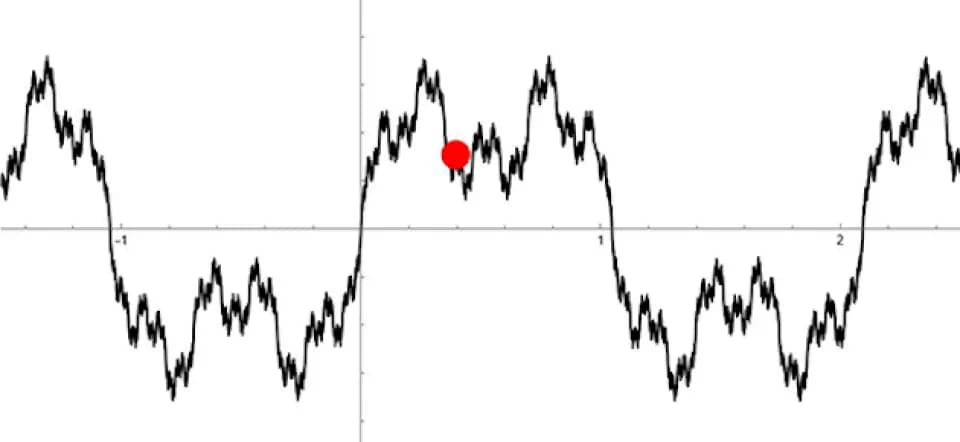
The appearance, in the late 19th century, of "astonishing objects" such as the graph of the Weierstrass function, the von Koch snowflake (see the article "The Man of Fractures") and the Sierpiński triangle called this simple notion of dimension into question.
Various definitions were proposed during the 20th century to make sense of the dimension of such objects. One of the most important was introduced in 1918 by Felix Hausdorff (1868–1942) and subsequently studied by Abram Besicovitch (1919–1970).