An object displaying self-similarity is generally described as fractal. From Romanesco broccoli to the patterns on certain seashells, countless forms in nature have been identified as "fractal" (see les Fractales, Bibliothèque Tangente 18, 2019). These forms often arise to satisfy constraints such as maximizing the surface area available for exchange between the inside and outside of a living organism.
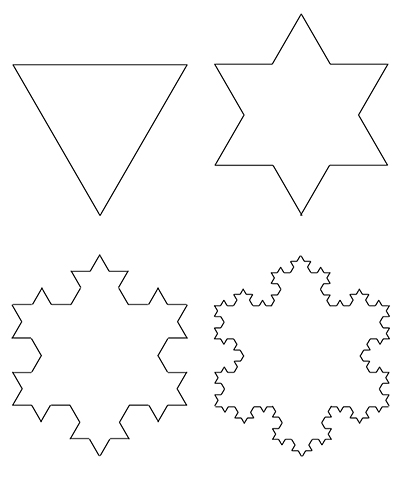
The first stages in constructing a von Koch snowflake (each line segment is divided into three equal parts, and the middle third is replaced by two line segments of the same length). The snowflake is the limiting curve obtained by repeating the process indefinitely.
Mathematical models of these fractal forms generally produce "rough" objects, with irregularities at every scale. Such surfaces are anything but smooth. A classic example is the von Koch snowflake, a curve that never resembles a line, however closely we examine it: no matter how near we get, its irregularities make it look like a broken line.
Yet fractals are not inevitably rough: surfaces can be both fractal and smooth! Such surfaces have recently emerged from effective solutions to two seemingly unrelated kinds of geometric constraint: compressing a sphere to reduce the volume it occupies, and representing in our three-dimensional space a surface whose "natural habitat" is four-dimensional (Euclidean) space.