The Dupin cyclide
-------------------
In 1822, in his book Application de géométrie, the French mathematician, engineer and politician Charles Pierre Dupin presented a non-spherical surface whose lines of curvature were nevertheless all circles. He named such surfaces cyclides.
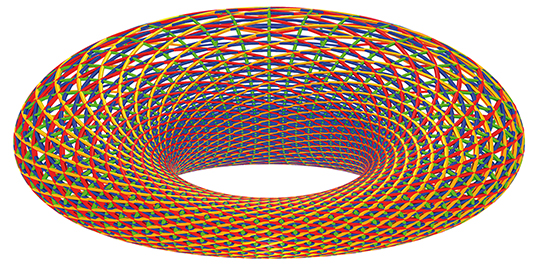
For Dupin, a cyclide was the envelope of spheres tangent to three fixed spheres. For the British mathematician Arthur Cayley, however, a cyclide was the envelope of spheres whose centers lay in a given plane and which were tangent to two given spheres. For James Clerk Maxwell, meanwhile, a cyclide was a surface whose normals all passed through two conics. Finally, a cyclide is the inversion of a torus, which explains why four circles pass through each of its points: the meridians (in green), the parallels (in blue) and the images of the Villarceau circles (in red and orange). The torus is a special case of a cyclide. Cyclides have an astonishing number of properties, which make them useful in computer graphics for joining surfaces.
-
Bézier patches
----------------------