At the beginning of the 19th century, Jean-Victor Poncelet studied polygons inscribed in one conic and circumscribed about another. Tracing the perimeter of such polygons produces a closed trajectory on a closed curve, a special case of the dynamical systems studied by the greatest mathematicians, from Henri Poincaré (1854–1912) and Jean-Christophe Yoccoz (1957–2016) to Artur Ávila (born in 1979). Imagine a billiard ball moving without friction and obeying Descartes' law of reflection whenever it bounces off the boundary of a closed billiard table. This is known as specular reflection (like light reflected by a mirror). The question is whether closed trajectories—whose starting and finishing points coincide—exist for a billiard table of a given shape. But this mathematical, and therefore perfect, billiard model also has more playful applications in arithmetic, such as solving watery problems that are not so silly after all (see FOCUS).
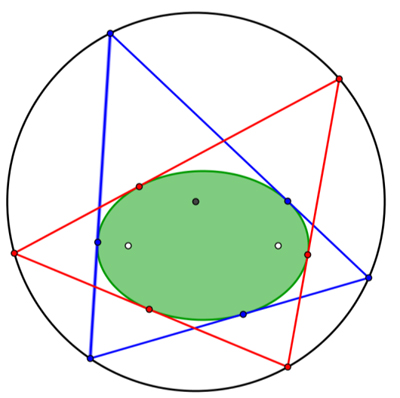
The configuration studied by Poncelet.
-
Billiard trajectories
----------------------------