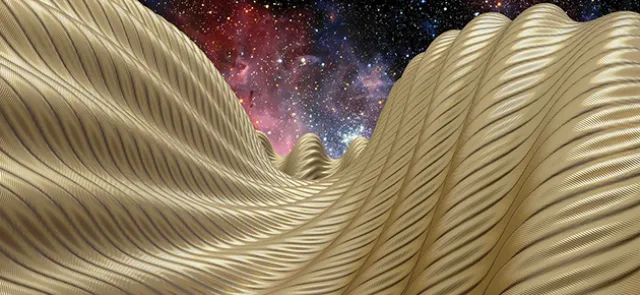
In their project, named Hévéa, a team of researchers from Lyon led by Vincent Borrelli (2015 Tangente Prize) achieved an extraordinary feat: they fitted a sphere, a priori neither stretchable nor compressible, inside a… ping-pong ball!
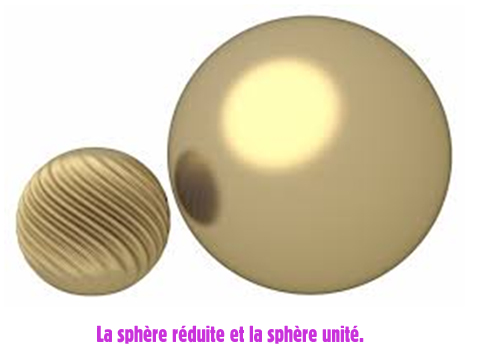
These mathematicians knew that a sphere could not undergo a twice-differentiable deformation that preserved the lengths of its curves. But they built on Kuiper and Nash’s result that this was no longer true if the deformations were required to be only continuously differentiable. They thus achieved the unthinkable: isometrically shrinking a unit sphere (of radius 1) into a smaller ball—a much smaller one—while preserving every geodesic distance, that is, the length of the shortest arc joining any two points. They described the explicit construction and visualization of this shrunken sphere in the journal Foundations of Computational Mathematics on July 6, 2017. Their "corrugated" sphere consists of two perfectly smooth spherical caps connected by a fractal equatorial belt. The transition is rather like passing from a von Koch curve to a line segment: what we have is a "smooth fractal", as Vincent Borrelli puts it.