A needle, a century overdue
Imagine a needle lying on a table. You want to rotate it through 360 degrees — to make it point in every possible direction. What is the smallest area you need to carry out this rotation? The question, posed in 1917 by the Japanese mathematician Sôichi Kakeya, seems almost childishly simple. Yet it held out for a century.
In 2025, Hong Wang and Joshua Zahl published a 127-page proof that definitively settles the three-dimensional case of this problem. On 23 July 2026, at the opening of the International Congress of Mathematicians in Philadelphia — the first held in the United States since 1986 — Wang received the Fields Medal. She thus becomes the third woman to win this award in its 90-year history, after Maryam Mirzakhani in 2014 and Maryna Viazovska in 2022.
Three other mathematicians share the Fields Medal class of 2026: Yu Deng, John Pardon and Jacob Tsimerman. But it is Wang's work that has captured attention, and for good reason: it closes a chapter opened before the First World War.
What the needle really hides
Let's return to the table. In two dimensions, the answer to Kakeya's question is counterintuitive to the point of being almost shocking. The Russian mathematician Abram Besicovitch proved that sets can be constructed containing a line segment in every possible direction, with an area as small as you like — tending to zero. In other words, a needle can point in every direction of the plane while occupying, in total, an almost zero area. This alone should already unsettle your geometric intuition.
But the Kakeya problem does not stop there. The real modern question, as explained in the educational work by Vincent Borrelli and Jean-Luc Rullière, concerns the dimension of these strange sets. In two dimensions, the case has been settled since 1971, thanks to Roy Davies: even though the area can be zero, the fractal dimension of these sets is indeed 2. But in three dimensions? There, the problem resisted.
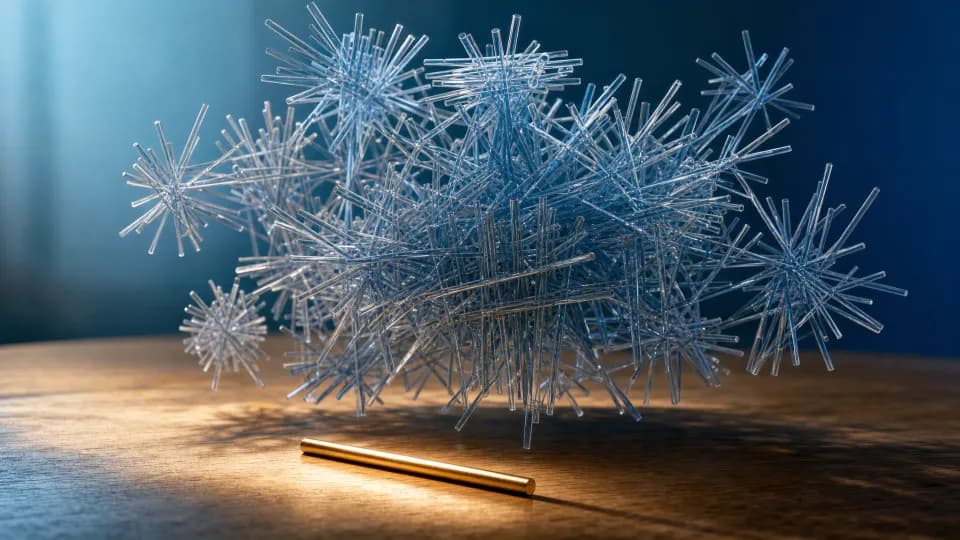
The 3D Kakeya conjecture states that any set containing a line segment of length 1 in every direction of space must have a Hausdorff dimension and a Minkowski dimension both equal to 3 — that is, it is, in a precise sense, as "large" as space itself. No trick is possible, no geometric shortcut. For decades, the world's best mathematicians managed only to establish partial bounds. Thomas Wolff had obtained a bound of dimension 2.5 in 1995 via what is known as the hairbrush argument (literally, the hairbrush — a configuration of tubes radiating from a central axis). Katz, Łaba and Tao then improved these bounds in small increments. The full conjecture, however, held firm.
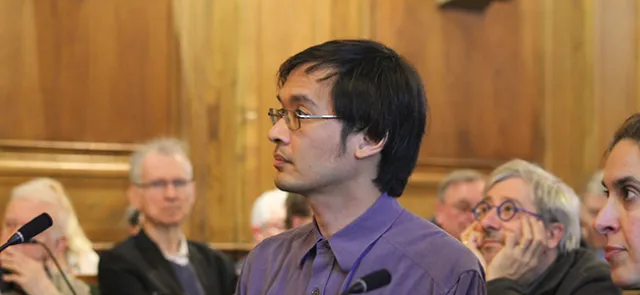
Wang and Zahl took that final step. Their proof, posted on arXiv in February 2025, establishes that every Kakeya set in three-dimensional space indeed has dimension 3. The strategy rests on a sophisticated multi-scale analysis: space is cut into very thin tubes, "sticky" configurations (where the tubes tend to cluster together) are distinguished from "non-sticky" ones, and each case is treated separately. Terence Tao, who devoted a long blog post to the proof, notes drily: "The proof is long — 127 pages!" No error has been found since its publication.
Why a needle interests wave physicists
One might ask: what is all this good for? The answer reveals something beautiful about how mathematics works. Kakeya-type problems do not live in some isolated corner of geometry — they sit at the heart of a dense network linking harmonic analysis, partial differential equations and arithmetic combinatorics.
Harmonic analysis is the art of decomposing functions into waves — much as a musical note can be decomposed into its harmonics. Understanding how these waves concentrate in certain directions amounts precisely to understanding configurations of tubes pointing in every direction. This is why, as the mathematician Pablo Shmerkin of the University of British Columbia explains in a profile published by Quanta Magazine, "all these connections explain why this field is considered so central and why Hong is so celebrated."
Larry Guth, Wang's doctoral advisor at MIT, sums it up with disarming candor: "I never solved the Kakeya conjecture, but there were four or five times when I thought I might get there." Wang, at 35, has succeeded where generations of mathematicians stumbled.
A career like no other
Born in 1991 in a village in Guangxi, in southern China, Wang skipped two grades in primary school. At 16, she entered Peking University to study Earth and space sciences — then switched to mathematics a year later. At 20, she left China to join the École polytechnique in France, followed by a master's degree at the University of Paris-Sud, then a PhD at MIT under the supervision of Larry Guth, defended in 2019. A postdoctoral position at the Institute for Advanced Study, a professorship at UCLA, then at NYU's Courant Institute — and since September 2025, a research position at the Institut des Hautes Études Scientifiques, while retaining her New York post.
This intercontinental career is no minor detail. Wang and her co-laureate Yu Deng are the first Chinese nationals to receive the Fields Medal since Shing-Tung Yau in 1982, as reported by The Hindu. Two laureates out of four, from a single generation trained between Beijing, Paris and leading American universities — a fact that says something about the international circulation of mathematical talent.
The other three: the full picture
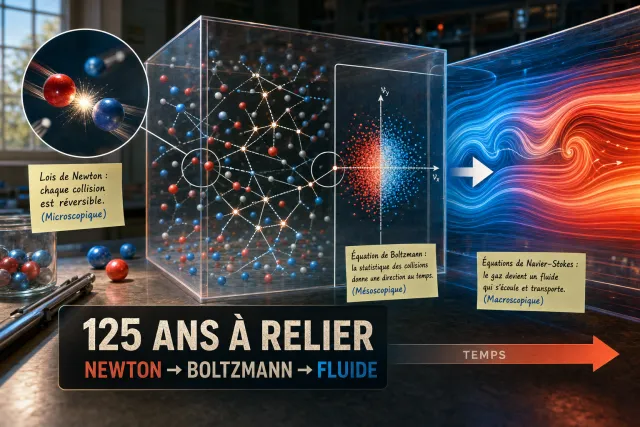
The co-laureates round out a picture of contemporary mathematical research. Yu Deng, born in 1989 in Henan and now a professor at the University of Chicago, solved — together with Zaher Hani and Xiao Ma — part of Hilbert's sixth problem, the 1900 program that called for physics to be rigorously grounded in mathematics. Their contribution: deriving the Boltzmann equation, which describes how gas particles behave collectively, from the laws governing individual collisions between hard spheres.
John Pardon, 37, a professor at the Simons Center for Geometry and Physics at Stony Brook, works in symplectic geometry — the geometry that describes how physical systems evolve over time. He solved the twenty-year-old MNOP conjecture, on the counting of curves in complex geometric spaces called Calabi-Yau manifolds. Jacob Tsimerman, 38, of the University of Toronto, found applications of o-minimality — a tool from mathematical logic — in arithmetic geometry, notably proving the Griffiths conjecture. On the very day his medal was announced, Tsimerman announced that he was joining OpenAI's safety research group.
According to the International Mathematical Union, each laureate receives 15,000 Canadian dollars — about 10,600 US dollars. It is not the amount that matters. What matters is what IMU president Hiraku Nakajima said at the ceremony: "These four medalists embody the depth, originality and vitality of contemporary mathematics."
For Wang, that vitality comes down to one sentence she let slip after publishing her proof: "No one can come along and say: 'Oh, actually, that's not true.'" A hundred years after Kakeya, the needle has finally found its place in space.