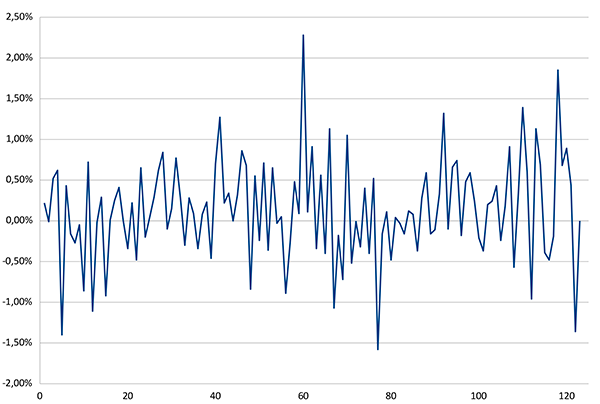
The theoretical treatment of risky financial products presents a challenge. The first sophisticated attempts at modelling date from the very end of the 19th century and arose from the research of French mathematician Louis Bachelier (1870–1946), whose results attracted little attention, if they were known at all, until Benoît Mandelbrot brought them out of obscurity.
The limitations of normal-distribution models
----------------------------------------------
Consider, for example, the recent "daily" returns observed for the CAC 40 and shown in the graph below—"daily" here means over the variable time intervals between two consecutive trading days. Their mean (0.13%) and standard deviation (0.622%) are easily calculated, allowing us, under the assumption of normality, to construct an interval that should theoretically contain 99% of the observations: [-1.48%, 1.73%].
In reality, however, 3% of the observations lie outside this interval—three times as many as expected! This is a well-known fact: the distributions of observed returns on financial products do not follow a normal distribution (represented by a bell-shaped Gaussian curve) but are leptokurtic (see box).