Statistical methods can sometimes be brought to bear on surprising problems. Any of us may encounter people claiming to be "clairvoyants" or "mediums" and therefore to possess supernatural powers. It is very difficult to know how to respond to such claims. Systematic skepticism allows proponents of clairvoyance to label you closed-minded and therefore unscientific. Accepting the supernatural (a strange concept, since all real phenomena are by their very nature natural) will very quickly make you seem naive.
In fact, the scientific response to such claims must always be skepticism, although this does not mean rejecting every claim a priori. Statistical methods can effectively test the actual performance of those who maintain that such phenomena exist. Interestingly, this statistical investigation also allows us to rediscover every aspect of hypothesis testing!
The virtues of skepticism
-------------------------
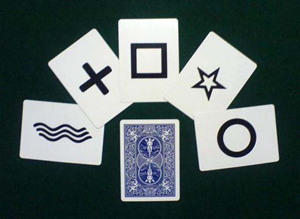
The American Banks Rhine was among the first to study paranormal phenomena scientifically. To this end, in 1920 he created a deck of twenty-five cards bearing five easily distinguishable symbols, each appearing five times in five different colors (black, blue, red, yellow and green). Known today as ESP (for extrasensory perception), Rhine named the deck "Zener cards" in honor of one of his colleagues, Karl Edward Zener (1903–1964). It contains five cross cards, five wave cards, five circle cards, five square cards and five star cards.