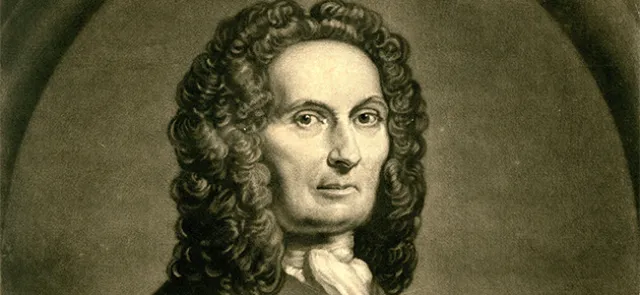
Pierre-Simon Laplace is often remembered for his atheism and his genuine profession of faith in a resolutely deterministic view of the universe. At the same time, the French scientist made a significant contribution to the development of probability theory.
From determinism to probability
--------------------------------
Curiously, the Norman mathematician's assertion of determinism appears in the introduction to his Essai philosophique sur les probabilités (see page 36). In the first section of his introduction, entitled "On probability," he writes:
"We must therefore regard the present state of the universe as the effect of its previous state and the cause of the state that will follow. An intelligence that, at a given instant, knew all the forces animating nature and the relative positions of the beings composing it […] would encompass in a single formula the motions of the greatest bodies and those of the lightest atom: nothing would be uncertain to it."
Quantum mechanics, developed more than a century later, would, as we now know, disprove this overly radical view. Yet it is interesting to understand why the staunchly deterministic Laplace took such an interest in probability theory. As early as 1772, at the age of 22, he made his mark by publishing his first Mémoire sur l’analyse des hasards, followed a year later by a second memoir with an equally telling title: Mémoire sur la probabilité des causes par les évènements. Thirty-seven years later, in 1810, he returned to probability theory with a new memoir, Mémoire sur les approximations et leur application aux probabilités, followed two years later by his major work, the Théorie analytique des probabilités (see page 38).