



A new approach to probabilities
Although convinced of the deterministic functioning of the Universe, Laplace notably contributed to the development of probability calculus, bringing it into the field of mathematics. One would be tempted to see a paradox there. The scholar is actually interested in practical problems. Typically, how to choose the 'most relevant' value among several measurements? From his research, he builds a theory that leads to the normal distribution.
All articles in this folder

Laplace on probability and metaphysics | Tangente
When Laplace took up a seat in the Senate, he thought his active involvement in science was effectively over. Yet he went on to state a fundamental law of probability theory, before exploring the philosophical implications of his findings in this emerging new science.
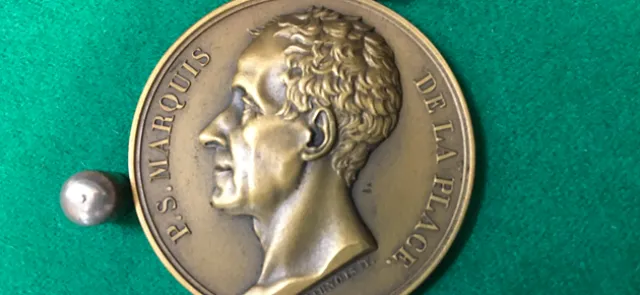
Laplace's many mathematical functions | Tangente
In his scientific work, Laplace introduced and used numerous mathematical functions. Alongside the Laplacian and the Laplace transform, we find generating functions and the potential function.

Will the Sun rise tomorrow?
Should we live each day as though it were our last? The question is a fair one, given that in 1814 Pierre-Simon de Laplace put the probability of the Sun rising again the next day at 0.99999945…

Three laws of error
Observations of celestial bodies are invariably subject to error. How can we choose the "most relevant" value from several measurements? Laplace, along with Legendre and Gauss, developed theories that ultimately led to the celebrated normal distribution.

Census-taking and the normal distribution
To calculate France's population, Laplace proposes a sampling method based on births and introduces the normal distribution to estimate the error. It would take until the 21st century for Insee to draw inspiration from his method.

The first law of large numbers
Repeating a random experiment with two possible outcomes a large number of times leads to probabilities that are difficult to predict directly, let alone calculate explicitly. Yet the de Moivre–Laplace theorem provides an excellent approximation.

The first law of large numbers
Repeating a random experiment with two possible outcomes a large number of times leads to probabilities that are difficult to predict directly, let alone calculate explicitly. Yet the de Moivre–Laplace theorem provides an excellent approximation.

Laplace: philosopher of chance and determinism | Tangente
The chief architect of determinism, Laplace marked a crucial milestone in the transformation of probability theory into a fully fledged branch of mathematics. Is that a paradox, or a coherent intellectual approach? Let's return to his writings to find out!