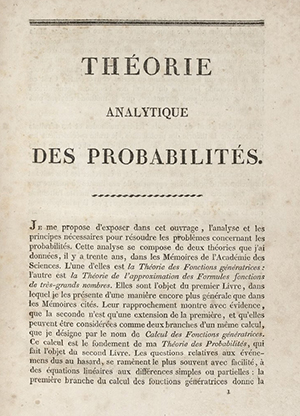
Laplace gave us the first definition of determinism, while remaining fully aware that in practice it would always be impossible to predict everything. This explains his commitment to developing probability theory! His book Théorie analytique des probabilités revisits and expands upon numerous articles on the subject that he wrote during the last quarter of the 18th century, drawing on advances in mathematical analysis and particularly on methods he had devised himself, such as the concept of a generating function.
A pioneering work
-------------------
Laplace begins with a very long philosophical introduction, which "is an expanded version of a lecture on probability [that he gave] at the teacher-training colleges in 1795". In this 169-page text, he adopts an approach rarely found among scientists. Keenly aware of the importance of the theory he goes on to develop, he "hopes that the reflections scattered throughout this introduction may merit philosophers' attention and direct it towards a subject so worthy of their consideration."
In the opening lines, he asserts that "almost all our knowledge is merely probable; and among the few things we can know with certainty, even in the mathematical sciences, the principal means of arriving at the truth—induction and analogy—are founded on probabilities; thus the entire system of human knowledge is connected with the theory set out in this essay". He then presents the "general principles of probability theory" in a literary style. Although commonplace today, this is in fact one of the earliest texts to explain what a probability is and how to calculate an event's probability. Laplace tells his readers that "the probability of events serves to determine the hopes or fears of those affected by their occurrence." In his "theory of chance", he defines expected value as "the product of the expected amount and the probability of obtaining it", offering a "moral" argument for introducing the concept by declaring "that an equal degree of probability confers an equal right to the expected sum."