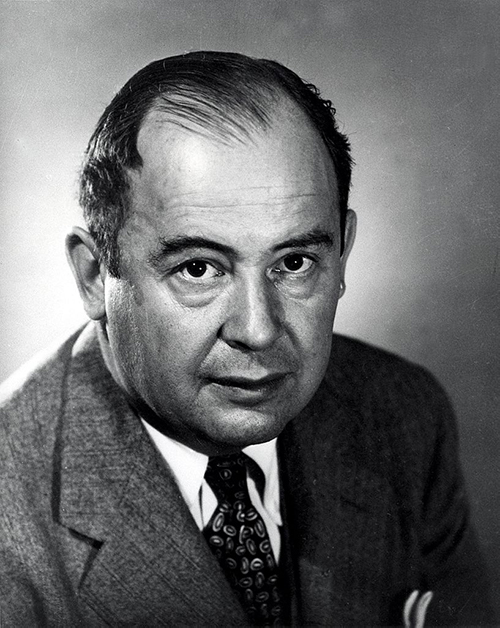
John von Neumann (1903–1957).

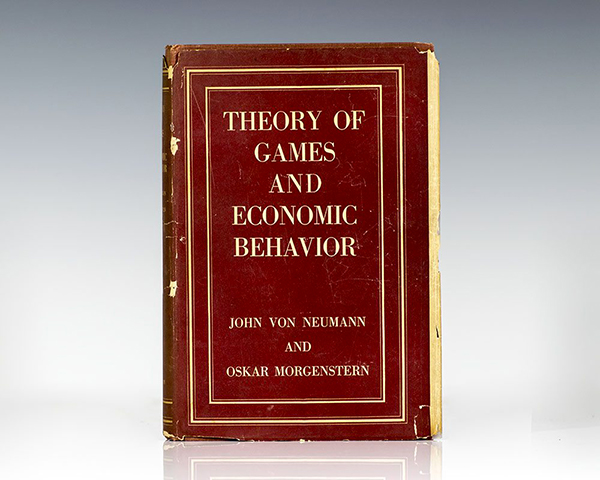
Toward the end of the Second World War, the celebrated mathematician John von Neumann and the economist Oskar Morgenstern broke new ground by providing a mathematical foundation for the strategic behavior of players and economic agents.


Articles recommended for you.

Faced with a lottery offering two different prizes, people adopt different strategies. Why do some participants prefer a potential prize that is not the largest? Their choices depend on how each person conceives of probability—whether as a one-off event or one that will be repeated.

The paradox formulated by the French economist Maurice Allais exposes a contradiction in an earlier theory of decision-making. But the paradox is only apparent and, above all, illustrates a major limitation of rational choice theory.

Can a game in which one player's gain is the other's loss benefit both players? That was the question Martin Gardner posed in 1980 with his "Loser Takes All" problem. More than forty years on, the paradox remains as relevant as ever!

The Banach–Tarski paradox claims that, in theory, the pieces of a single loaf can be turned into two loaves. It fell to the protean genius John von Neumann to explain the underlying reason for this mathematical miracle. The notion of amenability that he introduced then spread widely.
Discussion
Sign in to post a comment and talk with other readers.
No comments yet. Be the first to respond.