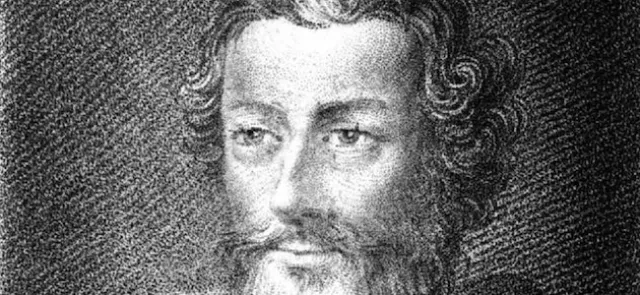
In the preface to his Isagoge, published in 1591, the mathematician from the Vendée claimed to have pioneered a "new art that allows [him] to solve twenty problems at once, whereas ancient and contemporary mathematicians dealt with them only one by one." He set out, step by step, the procedure for obtaining the solution to an algebra problem.
In Chapter V of this work, he introduced the term "zetetics" to express the need to reserve certain letters—usually vowels—for known quantities, called data, and others—usually consonants—for unknown quantities (the incertitus). The point, of course, was to produce results that applied more generally.
That same year, Viète wrote Zeteticorum libri quinque ("The Five Books of Zetetics"), published in 1593, in which he put these new methods into practice by studying problems already tackled by Diophantus. He probably chose the term "zetetics," from the Greek zetein, meaning "to seek knowledge," to emphasize that the method matters more than the result.
After Viète, the word "zetetics" remained in use for around two centuries: it appears in Furetière's famous dictionary, published in 1690, where it is defined as follows:
"A mathematical term. The zetetic method is the method used to solve a problem." How many of us have practised zetetics without knowing it?
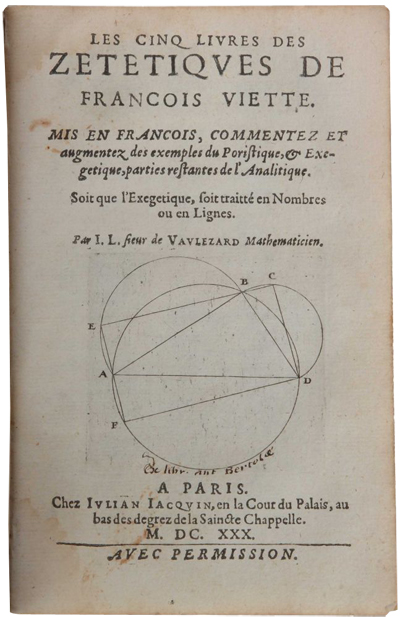
Zeteticorum libri quinque in its French translation, published in 1630.