
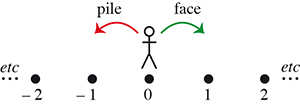
Imagine a little game, seemingly harmless: place someone in the middle of the living room, equally far from the walls to their left and right. Toss a coin. Whenever it comes up heads, ask them to take one step to the left; whenever it comes up tails, one step to the right. After ten tosses, where will our obedient walker be? How many tosses will it take for them to reach one of the two walls? And which wall will it be? The left-hand wall? The right-hand one? The game may seem absurd and the questions it raises pointless. Yet it lies behind one of the most spectacular advances in the history of mathematics: the emergence of stochastic processes.
Stochastic or random?
---------------------
The term "stochastic" has only recently come into use. Until the mid-20th century, the preferred term was random processes. This semantic shift reflects a drastic paradigm shift, as the etymology makes abundantly clear. The term "random" derives directly from the Latin aleatorius, meaning "related to games of chance"; it contains the root aleum (chance and, by extension, the die and dice games). The term "stochastic" derives from the Ancient Greek stochastikos, meaning "conjectural." It contains the noun stochos, denoting the goal to be reached, the target.
The two approaches treat randomness differently. The first makes no attempt to manage it. In the second, randomness can be brought under control or put to use. A remarkable novel by Robert Silverberg explores how mastery of chance might affect our society: L’Homme stochastique (Robert Laffont, 1977). Lew Nichols, an expert in stochastic calculus, bases his view of the world on a rational analysis of the past and a suitable model—a term with a very particular meaning in probability—of the future. This allows him to lift a corner of the veil concealing what lies ahead.