The tides had intrigued the ancients ever since explorers first left the Mediterranean basin and ventured to the shores of the Atlantic. The first to record observations of them was probably Pytheas of Massalia. Around 325 BCE, this Greek astronomer from Massalia (modern-day Marseille) embarked on a scientific voyage lasting several months that took him north of the British Isles and probably as far as Iceland. This enabled him to observe two tides per lunar day and variations in their amplitude with the phases of the Moon.
The first scientific investigations
-----------------------------------------
For nearly two thousand years, various fanciful explanations were proposed, including Descartes's "vortices." But as Laplace explained in his Traité de mécanique céleste: "Newton was the first to provide the true theory of the ebb and flow of the sea, by connecting it with his great principle of universal gravitation." Laplace again explains Newton's account of the tides: "Newton's theory appeared in 1687, in his Mathematical Principles of Natural Philosophy. […] The true explanation of this phenomenon is contained in Propositions 26 and 27 of Book Three, where Newton determines the forces exerted by the Sun and the Moon to move the waters of the sea."
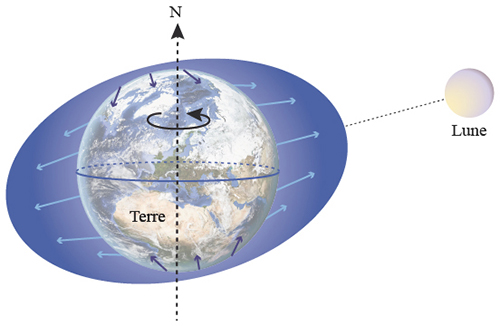
Newton assumed that the Earth was entirely covered with water and studied the shape this body of water would take under the influence of the Moon on the one hand and the Sun on the other. To understand his reasoning, we must realize that the attraction exerted on the water by each of these two bodies results from the difference in its gravitational attraction to the water and to the Earth (that is, its center). Since gravitational force is inversely proportional to the square of the distance, this difference is greatest both toward the body and in the opposite direction.