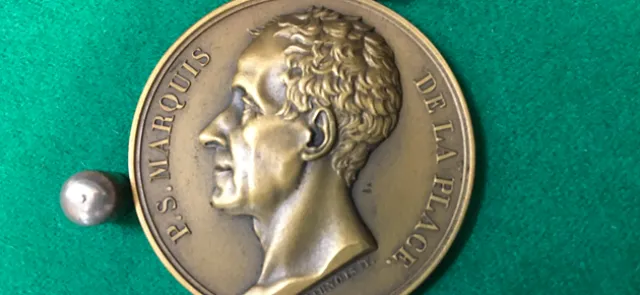
Our Solar System consists of a star, the Sun (which accounts for about 99% of its total mass); nine planets, including Jupiter (whose mass exceeds that of the other eight combined, together with everything else), and their moons; comets; asteroids; and… a great deal of empty space. From the outset, this system—partially observed, and from afar—has exerted a genuine fascination over humankind and raised major scientific questions. Improvements in observational methods and mathematical tools—particularly infinitesimal calculus, developed by Leibniz and Newton, and later by Lagrange—and the advent of the law of universal gravitation, a scientific turning point that provided the main foundation for Laplace's work, paved the way for the development of mathematical physics. The Traité de mécanique céleste incorporates a 1782 paper by Laplace on the attraction of spheroids. In it, the scholar writes—in the version published later under the auspices of the Académie des sciences—that "this attraction is given by the partial derivatives of the function expressing the sum of the molecules divided by their distance from the point attracted" (a function Laplace denotes by V). He then adds: "in rectangular coordinates, we shall likewise have ". In modern terms, this is Laplace's partial differential equation (PDE), satisfied by the gravitational potential V; he stresses that "it will be of the greatest use in the theory of the figure of celestial bodies", that is, in describing their trajectories. The same equation is in fact a local expression of Newton's law of gravitation. From this law, the Norman mathematician would derive a law governing the motion of the Jupiter–Saturn pair that agreed with every table of observations compiled up to that time, without recourse to an empirical correction.
From the equation to operators
----------------------------
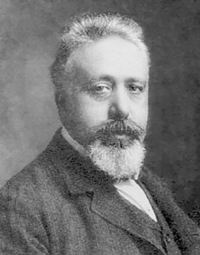
Ideas developed by the Italian school of mathematics around the turn of the 20th century—notably by Vito Volterra, Salvatore Pincherle and Giuseppe Peano, who speaks of infinite dimension—gradually led mathematicians to regard functions of one or more real variables not as correspondences ("to x we associate f(x)") but as points in an abstract space.