He had already provided a proof of its stability based on Newton's theory of gravitation, identifying the following five phenomena:
The various planets travel along their orbits in the same direction and "more or less" in the same plane; their satellites orbit in the same direction as the planets; these various bodies, including the Sun, rotate in planes "only slightly different" from their orbital planes and in the same direction; the eccentricities of the orbits of the planets and their satellites are "very small"; the orbits of comets have "large" eccentricities and widely varying inclinations.
Laplace's cosmogonic model
---------------------------------
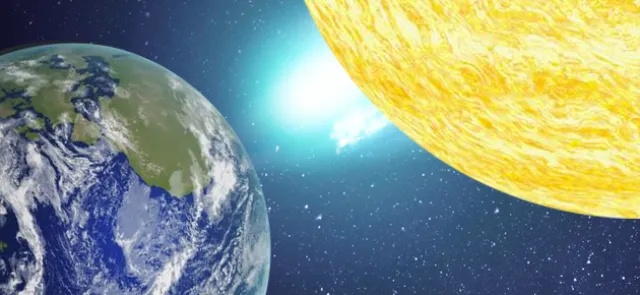
Drawing on the observations that had led him to establish the stability of the Solar System (see above), Laplace did not even consider the model proposed by René Descartes (1596–1650), with its vortices. Instead, he corrected and improved the model proposed by Georges-Louis Leclerc, Comte de Buffon (1707–1788), who assumed that a comet had ejected a quantity of matter from the Sun that would later form the planets.
Invoking the conservation of angular momentum, Laplace argued that a rotating cloud of matter occupying the space of the Solar System first condensed into a disk, then into rings, which ultimately condensed into planets, all driven by the rotation of the original cloud. The Prussian philosopher Immanuel Kant had proposed the same model before him, but Laplace was unaware of it.
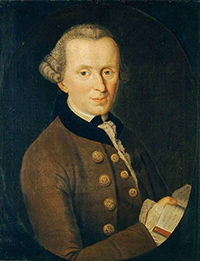
Immanuel Kant (1724–1804). Portrait by Johann Gottlieb Becker, 1768.
This theory, often called the Kant–Laplace model, extends naturally to the formation of satellite systems around certain planets, as well as to other stellar systems and galaxies, and closely resembles the theoretical model accepted today.