Mathematics arose long ago: no sooner had people learned to count than they needed names for numbers. Then they wrote them down. The world's earliest trace of a numeral system dates back twenty thousand years and was discovered in the 1950s in what is now the Democratic Republic of the Congo: the Ishango bones, about ten centimetres long. They bear groups of notches that are undoubtedly numerical representations, rather like the Roman practice of writing "III" to represent the number three.
At that time, numbers were used to count people, animals and days. In the 4th century BC, Plato wrote in the Timaeus that we invented numbers by observing the recurrence of day and night, winter and spring. From this, he inferred that numbers exist in our minds only because we possess senses, particularly sight, which enables us to notice these recurring patterns. Numbers thus originated as perceptible objects used to characterize other objects by their quantity.
Pythagoras and his school
----------------------
The Greeks always admired their predecessors: the Egyptians, Babylonians and Phoenicians had developed considerable skill in performing calculations with numbers and geometric figures. The Phoenicians needed this expertise for commercial calculations, the Babylonians to devise calendars, and the Egyptians to calculate the taxes owed to the pharaoh on arable land. According to Herodotus (in his Histories, around 445 BC), this was how geometry arose: when the Nile flooded a field, its farmer did not have to pay tax on the submerged area. The Egyptians therefore became interested in unit fractions—parts of a whole—to such an extent that numbers of the form 1/2, 1/3, 1/4, 1/5…, whose numerator is 1, are now known as Egyptian fractions.
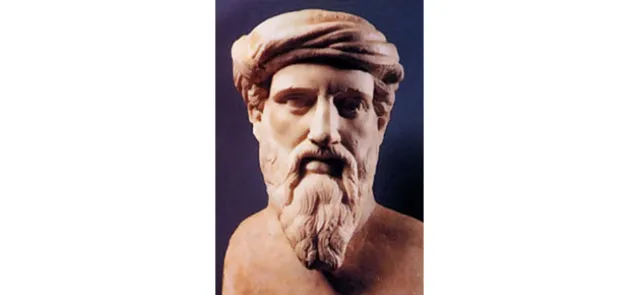
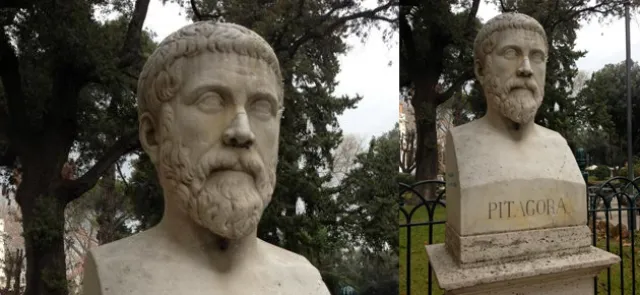
One day, a man from a small Greek island off the coast of present-day Turkey travelled to Egypt to study mathematics and philosophy with the priests. When Egypt was conquered by the Persians, he was taken to Babylon, whether he liked it or not, and seized the opportunity to further his education. After returning home from a good twenty years of what we would now call an Erasmus, he moved once again and finally settled in southern Italy. That man was Pythagoras of Samos—the Pythagoras whose namesake theorem students encounter in middle school, although he himself had learned it from the Egyptians and would never have had the audacity to claim it as his own discovery.