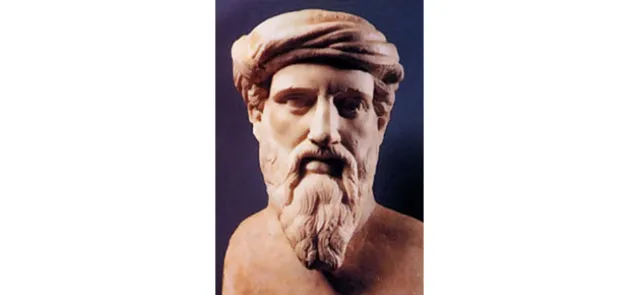
Pythagoras's biographers (c. –580; c. –500) lived long after him, as did the mathematicians who studied his work and that of his disciples, so their accounts are sometimes open to question. Yet they all agree on one point: how he discovered the connection between harmonious sounds and arithmetic.
The birth of a legend
--------------------------
Whether Nicomachus of Gerasa (c. AD 100), Iamblichus (died 330), Macrobius (early 5th century), or Boethius (c. 480–524), they all tell how Pythagoras one day discovered the mathematical theory of music while passing by a forge (see box). Hearing the pleasing harmonies produced as hammers struck the anvils, he is said to have realized that the sound of each blow was related to the hammer's weight. Returning home, he supposedly hung different weights from strings of equal length, set the strings vibrating, and succeeded in producing harmonious intervals: the octave, fifth, and fourth. Ancient sources suggest that the weights Pythagoras used were 6, 8, 9, and 12 (the unit does not matter; only the ratios between the weights count).
In reality, such weights would produce nothing very harmonious: they would need to be 1, 4, 9, and 16 to yield the octave (a doubling of the fundamental frequency), the fifth (whose ratio to the fundamental frequency is 3 to 2, or 1.5), and the fourth (whose ratio to the fundamental frequency is 4 to 3). The frequency of a vibrating string with a mass suspended from it is proportional to the square root of the mass, not to the mass itself, as all these ancient texts assumed. In the 17th century, Huygens, who took a keen interest in music, corrected the weights accordingly (see Christiaan Huygens's Œuvres complètes (Complete Works), Société hollandaise des sciences, 1937, vol. XIX, and les Représentations de la propagation du son d’Aristote à l’Encyclopédie, François Baskevitch's doctoral dissertation, 2008). Although the experiment described by ancient historians and mathematicians is inaccurate, they all nevertheless report an iterative method for defining a twelve-note musical scale: the Pythagorean scale. It may not have been used by Pythagoras himself, but probably by disciples of the Pythagorean school, Archytas and Philolaus, and remained the scale shared by all musicians until equal temperament emerged in the Baroque era.