The OEIS: what's that?
------------------
The OEIS (On-Line Encyclopedia of Integer Sequences) is an online encyclopedia of integer sequences that currently lists more than 300,000 sequences. Enter four or five consecutive terms (integers), and it will return every listed sequence, finite or infinite, containing that string. For each sequence, you will find various definitions, properties, formulas, examples showing how to construct its terms, references in print or online, and programs for computing its terms in different programming languages.
A sequence of rational numbers is listed by means of two sequences: one of its denominators and one of its numerators. The OEIS is also an encyclopedia of mathematical constants, represented by the sequences of their decimal digits. Its highly effective search engine can also search for words.
Neil James Alexander Sloane, a British-American mathematician specializing in combinatorics who was born in 1939, founded the encyclopedia. Although the website is now run by a foundation, Neil Sloane remains active there.
A few examples
-----------------
A search for the term "Fibonacci" in the OEIS will return not only the sequence of that name—though it will still appear first, as A000045—but 9,528 results to date!
For example, you will discover the infinite Fibonacci word (A003849): 0, 1, 0, 0, 1, 0, 1, 0, 0, 1, 0, 0… (start with 0, then repeatedly apply the transformation 0 → 01, 1 → 0 indefinitely).
A search for the string "look and say" will return Conway's look-and-say sequence (A003849), 1, 11, 21, 1211, 111221, 312211…, in which each term after the first is obtained by reading off the digits of the preceding term (see Tangente 191, 2019), along with 124 variants! Be warned: entering the separate words "look", "and" and "say" will return 211 sequences, including the 124 results already mentioned.
Did you know?
The first OEIS entry, sequence A000001, gives the number of groups of order n.
You have to wait until A000027 to find the strictly positive integers, A001477 for the non-negative integers, A005843 for the even integers and A005408 for the odd integers. The prime numbers form sequence A000040.
No one knows whether Hofstadter's Q-sequence (A005185) is defined for every integer.
Gijswijt's sequence (A090822) grows very slowly: the first term equal to 5 does not appear until the 1010 23th position!
The toothpick sequence (A139250) is simple enough for a child to understand.
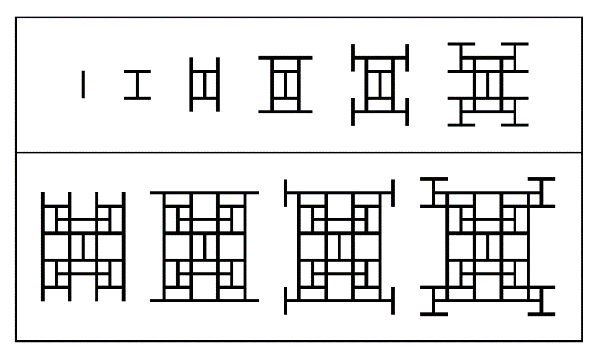
The first ten stages in the construction of the toothpick sequence:
1, 3, 7, 11, 15, 23, 35, 43, 47, 55.
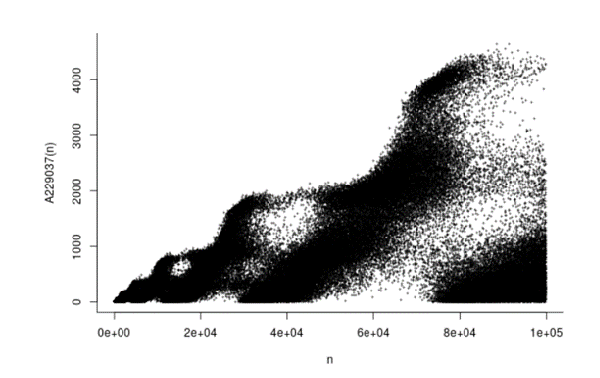
The forest-fire sequence is numbered A229037.
-
A living encyclopedia
------------------------
New sequences are added to the website every day. If you want to contribute information yourself, you will need to register and log in. You can then add a previously unknown sequence, preferably supplying around fifty terms and its defining property. If you modify an existing sequence, you must append your comments (in English) after everyone else's and sign them. As a result, classic sequences such as the Fibonacci sequence have numerous comments that are not organized at all, leaving the page looking rather cluttered…
Everything is in plain text, which is not necessarily pleasant either to write or to read. Approval of proposed changes by an authorized editor can sometimes take a while, and you cannot create or modify more than three sequences until your earlier submissions have been approved.
Despite all this, the encyclopedia is immensely valuable: it is the essential reference for sequences!