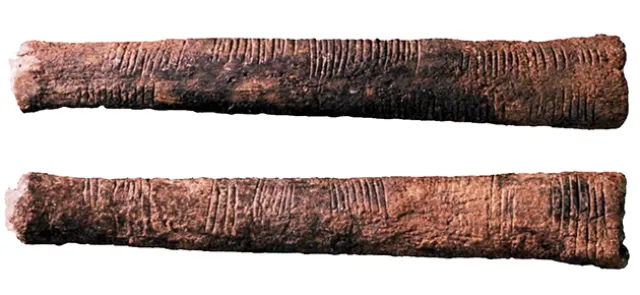
The ancient Greeks used an alphabetic numeral system that was ill-suited to calculation (α = 1, β = 2… ι = 10, κ = 20, ρ = 100, ς = 200…). They therefore relied on small counters called psephoi. These could be used on an abacus (like the Roman calculi, or "small pebbles") or for counting directly on the ground or a table. The simplest thing to do with these psephoi is to line them up, much as a prisoner marks off successive strokes on a cell wall. This immediately defines the linear number, the earliest and most obvious way of representing numbers, as Boethius recalls (Institution arithmétique (Arithmetic), II, 4, 5, 1, text edited and translated by Jean-Yves Guillaumin, Les Belles Lettres, 2002): "A linear number is an accumulation of quantity extending from 2, with one unit always added along one and the same line, as below:
II III IIII IIIII IIIII IIIIII IIIIIII IIIIIIII IIIIIIIII."
Of course, had matters ended there, figurate numbers would never have enjoyed the slightest success. It was the next step—from linear to triangular numbers—that would make them legendary.
Pythagorean origins
-------------------------
The most famous figurate number is attributed to Pythagoras: the tetraktys. It is the number 10, arranged as an equilateral triangle of ten points.