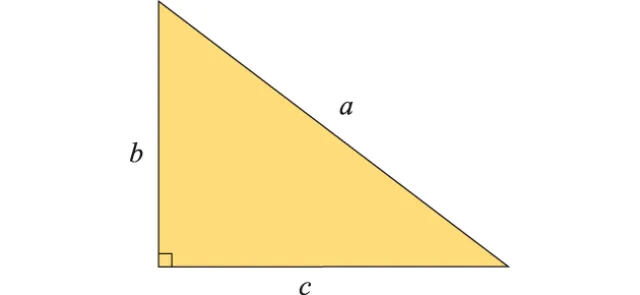
A triangle is right-angled if and only if the square of its longest side is equal to the sum of the squares of the other two. This is the statement of the so-called "Pythagorean theorem" of Euclidean geometry.
(3, 4, 5) is the best-known example of a triple of integers giving the side lengths of a right triangle. This has an application in the design of an instrument: the thirteen-knot rope, divided at regular intervals into twelve sections, can be used to mark out a triangle with side lengths 3, 4 and 5. This triangle is right-angled, and the thirteen-knot rope is said to have served as the set square of Egyptian builders.
A problem in integers
------------------------------
More generally, the equation *x 2 + *y 2 = *z 2, for which only solutions (x, y, z) with nonzero integers x, y and z are sought, is called the Pythagorean equation, and its solutions are called Pythagorean triples. The question becomes a problem in arithmetic! This is an example of a polynomial equation in one or more unknowns whose solutions are sought among the integers, or possibly the rational numbers, with coefficients that are themselves also integers. Because of Diophantus of Alexandria's important and relatively systematic treatment of the subject—as attested by his Arithmetica in the 3rd century—this type of equation is called a Diophantine equation.
(3, 4, 5) is a Pythagorean triple, whereas , which satisfies the equation *x 2 + *y 2 = *z 2, is not (indeed, cannot be written as a fraction of integers, since this number is irrational).