



Pythagorean triples
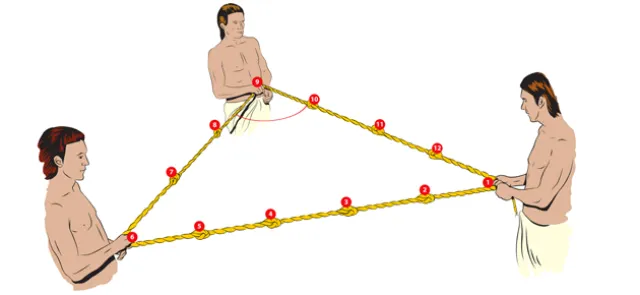
Which of our readers does not know the triple (3, 4, 5), embodied by the 'rope with thirteen knots' of the builders of ancient Egypt and then the Middle Ages? Why 3, 4, 5? Because 3² + 4² = 5², it's as simple as the Pythagorean theorem! This relationship links the lengths of the three sides of the most elementary right triangle there is. Beyond these three numbers that have become mythical, exploring Pythagorean triples will not only make it possible to know that the Pythagorean theorem was already known long before the birth of the most famous scholar of Antiquity, but also to uncover the secrets of these groups of three integers, through the procedures that will make it possible to construct them. This will also lead to studying the different properties of all varieties of 'Pythagorean triangles'. But do you know that Fermat, to show that 'the area of a right triangle cannot be a square', deduced his method of 'infinite descent'? The journey through this theme holds beautiful surprises!
All articles in this folder
The Pythagorean theorem before Pythagoras | Tangente
Pythagoras would never have accepted this result being named after him: he knew perfectly well that he had learned it on his journeys of study. As we shall see, it already existed in Babylon and India!

Pythagorean triangles
When the side lengths of a triangle form a Pythagorean triple, the triangle is called a Pythagorean triangle. Discover its properties...
Generating the famous Pythagorean triples
Characterizing all right triangles in the plane with integer side lengths amounts to finding all Pythagorean triples. The geometric problem thus appears to become purely arithmetic! How did mathematicians go about completing this quest?

Fermat's infinite descent explained | Tangente
Pierre de Fermat wrote that he had succeeded in proving that the area of a right triangle can never be an integer that is a perfect square. To do so, he introduced a method of reasoning that would go down in history: infinite descent.