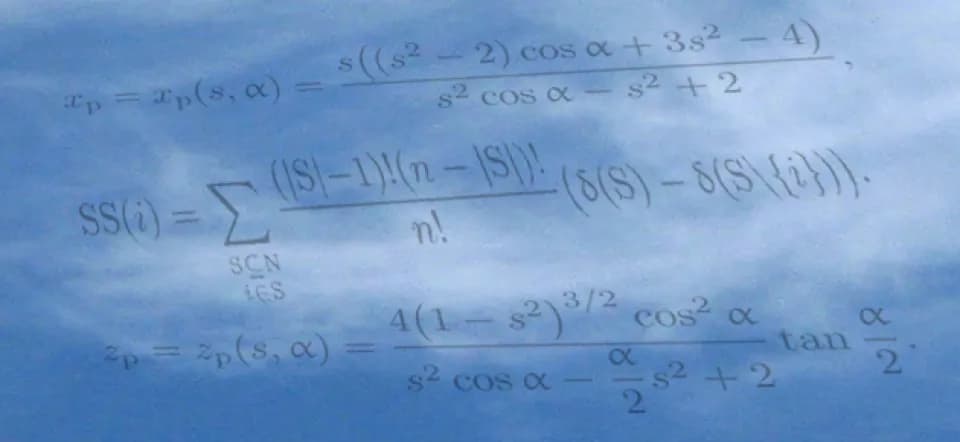
Who could fail to notice expressions or formulations known as "abuses of language" slipping more or less blatantly into mathematics lessons? We are told they are tolerated—and even claimed as such—for all sorts of excellent reasons. But who has stopped to consider that the existence of these abuses implies the existence of a "language" which, if not abused, might be that long-dreamed-of marvel: a "mathematically pure" language?
Symbols and formulas emerged only gradually from writing that was initially entirely rhetorical. We do not know who first watched them invade and colonize the discipline and thought that they alone might suffice to create mathematical objects and theorems. Today, however, we know that the "formalist" dream of a mathematics consisting of nothing but writing, purged of any impure, imprecise or ambiguous language, was laid to rest in the last century. We need only turn to Bourbaki, whose Éléments de mathématique states that, in such circumstances, "a rough estimate" shows that, for example, the term denoted by "1" would require "a string of several tens of thousands of symbols (each […] being one of the symbols τ, ⎕, ∨, ¬, =, ∈)." Just imagine what "1 + 1 = 2" would require.
Let us therefore accept that mathematics cannot do without words—and embrace their profoundly unequal status, knowing that words born of elevated intellectual activity must coexist with commonplace, everyday ones: the aristocratic "polyhedron" and the plebeian "block"; the serene perfection of the "torus" and the unruly agitation of a "ball"; the banality of an "equality" and the elegance of a "congruence"; the equivocal "relation" and the rigid demands of a "bijection"…
"Words" and "mathematics": mathematics appropriates words or draws inspiration from them, but ultimately turns them into smooth, unambiguous terms. How does this happen? The possibilities are staggering. Here are two such possibilities, explored in articles that, like illuminations, set the tone—or hint at their content.
Choosing words
-----------------