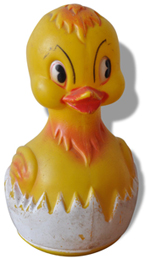
The earliest study of static equilibrium in convex bodies is surely Archimedes' treatise On Floating Bodies. His work on the way a ship's hull returns to equilibrium as its shape changes was still used in naval architecture in the 18th century. This subject takes concrete form in a toy found throughout the world: the roly-poly. This toy owes its one stable equilibrium point to a high-density mass embedded in its base and often has just one unstable equilibrium point, at its top. (Opposite: a Maréchal roly-poly toy from the 1960s.)
But if we seek convex, homogeneous objects of this kind, which we shall call regular here, the problem is far from trivial. Their non-existence in two dimensions is easily proved, but in three dimensions the existence of such a solid with only two equilibrium points—one stable and one unstable—remained a conjecture inspired by Russian mathematician Vladimir Arnold's intuition in 1995.
Convex and homogeneous bodies
==============================
We are interested in bodies resting on a horizontal plane in a uniform vertical gravitational field. Ever since the invention of the wheel, we have known that a continuum of equilibria is possible. Objects with a finite number of stable equilibria are commonplace; dice used in board games are familiar examples. An object with only one stable equilibrium point, such as a roly-poly toy or a tumbler doll, is called monostatic, and if it also has only one unstable equilibrium, it is described as mono-monostatic.