Post hoc, ergo propter hoc. With typically Latin concision, this aphorism means "after this, therefore because of this." In other words, "what happened was caused by what came before." But that is false: you may well break out in spots after eating almonds without there being any causal connection! If you react this way every time you eat almonds, however, it is reasonable to see the consumption of certain nuts as the cause of your hives: you are allergic. Yet this is not always so: two events may be correlated without the earlier one causing the later one.
Chance and coincidences
=======================
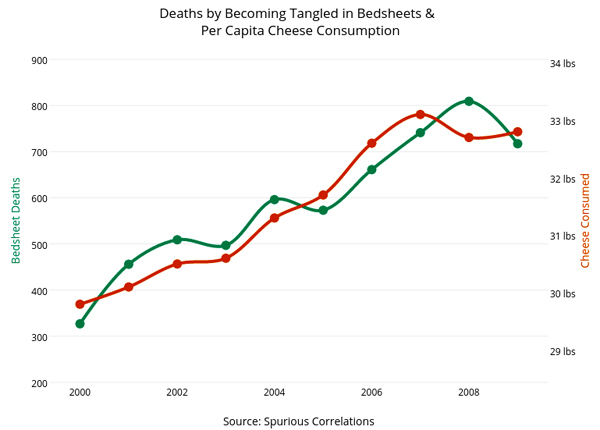
Let us first dispose of chance correlations, which are utterly useless except as a source of fraud. The mechanism is simple. Billions of events occur every year, and thanks to Big Data (see Tangente 181), we now have written records charting how several million of them have changed over time. Choose any one of them, and it would be astonishing not to find another among the remaining millions that resembles it! Especially when the scales used in the graph can be manipulated... By changing the scale of the y-axis, one can give the curves whatever average slope one likes. The Spurious Correlations website (tylervigen.com/spurious-correlations) offers plenty of outlandish but spectacular examples.
At the other extreme are causal correlations: whenever you run a 100-metre race, your heart rate rises.